
Portrait 06 of 15
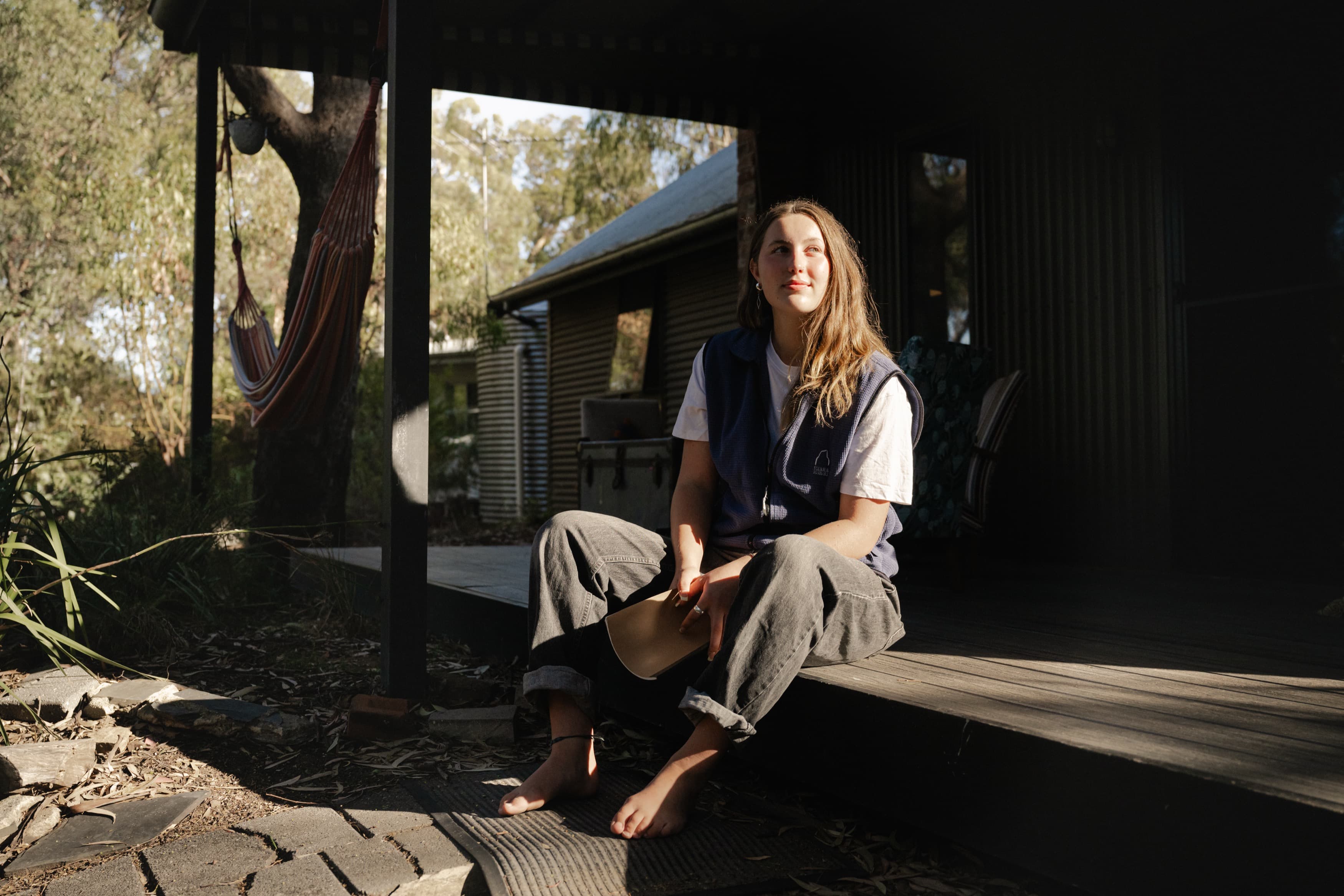
Dee
Governing Coastlines for the Long-Term
she/her · 16 · Kaurna Country (Adelaide), SA
Marine conservation · Coastal governance
The beach is her natural therapy. The place that heals her. And right now it smells like dead fish.
At 16, Dee grew up marching for causes and speaking about hard things openly. She was not prepared for watching her beloved beach turn brown from algal blooms, or for discovering that scientists had warned this would happen for decades while governance moved too slowly to act. Her portrait is about what happens when environmental policy is reactive by design - when the rules only kick in once the damage is already done - and what a generation raised inside that gap is starting to demand.
Through Dee’s eyes
Dee (she/her), 16 | Kaurna Country (Adelaide, South Australia)
Australian summers carry a certain promise: long bright days, salt on skin, beaches that feel endless. For Dee and her friends, this promise shaped childhood itself. Adelaide’s coastline was more than scenery. It was ritual, and relief. She calls it her “natural therapy. The one thing that heals me.”
That promise began to fade in 2025, when algae blooms reached South Australia. The early reports felt distant, until her treasured beach changed from “crystal blue and golden sand” to something “brown and smells like dead fish.” “The beach looks so depressed right now,” she says, searching for words that match the feeling. Even swimming became unsafe. Her most recent attempt left her itching and nauseous.
For Dee, the loss feels personal and familiar. She grew up with disaster in the background: bushfire evacuations, smoke-thick skies, and her father’s memories of the 1983 Ash Wednesday fires that led him into the Country Fire Service. The coastline’s collapse feels like catastrophe returning in a new form.
At 16, Dee moves readily through conversations many adults still avoid. She grew up in a home where delicate topics were spoken aloud. Her mother, a veteran community organiser, raised her among “incredible women and trans people who taught me that sensitive topics are something that I can engage with.” From that environment, and from marching at the frontlines of pro-choice advocacy, she gained both conviction and fluency. “I wish more people felt they could talk about these topics. Maybe we wouldn’t be where we are.” That upbringing shaped a commitment she carries forward. “No matter how much exposure I get, I will always feel passionate and emotional and affected.” She rejects the idea that passion should be restrained. “Showing that you really care needs to be normalised.”
Her story reflects a generation growing up inside a widening gap between the world they were promised and the one they are inheriting. They carry consequences created long before they were born, often with the expectation that they will absorb the impact quietly. The collapse of Dee’s beach shows how the cost of inaction appears first in the places young people are meant to inherit. When she speaks of the coastline, she is sounding an alarm. “It’s our life. My happy place. Where I reset. To see it in such distress. I don’t know where to go anymore.”
Policy, for Dee, is not a distant debate. It is dead fish on golden sand. It is losing the only place she feels whole. It is watching a world she assumed was stable shift beneath her feet. Her plea is disarmingly simple: “Go look at the beach.” The urgency is now widely recognised, though it took visible damage to make it undeniable. What remains unresolved is whether that recognition will translate into sustained, long-term commitment, or whether attention will fade as the crisis slips from view.
In Dee’s world, policy is personal, grief is intergenerational, and the demand for change grows from a simple instinct: to keep a place alive long enough to pass it on.


The policy trajectory of coastal health
Dee’s story shows coastlines deteriorating faster than decisions are made. Governance still focuses on visible damage and short-term repair, while monitoring systems, data continuity, and early intervention receive limited and unstable support. Ecological pressure builds across years, yet decisions often arrive only after critical thresholds have already been crossed, raising the scale and cost of recovery. Environmental decline becomes harder to reverse, and coastal economies face greater exposure. Younger Australians risk inheriting coastlines with weakened ecological function and fewer viable options to prevent further degradation.
The potential of future generations policy to intervene
A future generations policy approach shifts coastal governance toward earlier action in the degradation cycle. Strong monitoring systems, stable funding, and preventative decision-making allow governments to intervene before ecological damage becomes severe. These settings support healthier coastal ecosystems, more resilient local livelihoods, and continued access to places that anchor community identity and wellbeing.
Policy landscape
Today's policy landscape: South Australia's marine environment
South Australia’s State of the Environment Report explains why ecological decline reached public beaches before decisive intervention followed. Biodiversity is falling, habitats are contracting, and several coastal ecosystems that store carbon and support marine life are nearing collapse. As these systems degrade, ecological stability weakens and the state’s capacity to respond to climate risk diminishes.
Some progress has been achieved through Indigenous Protected Areas, but broader pressures continue to damage South Australia’s marine systems. Coastal development, dredging, nutrient and pesticide runoff, and invasive species place sustained stress on fragile ecosystems. 19 ecosystems are now classified as “in collapse.” These pressures persist because governance remains fragmented and intervention often begins only after visible damage occurs. Where coordination and sustained commitment exist, ecological decline can stabilise and recovery becomes possible.
Current policy ambitions sit uneasily within this context. Australia’s Strategy for Nature 2024-2030 commits the country to halting and reversing biodiversity loss by 2030, and Adelaide’s designation as the world’s second National Park City demonstrates how coordinated urban action can shift environmental outcomes. Yet much of Australia’s environmental governance still rests on an outdated legislative foundation. The Environmental Protection and Biodiversity Conservation Act (EPBC Act), introduced in 1999, primarily assesses environmental harm after it occurs. Enforcement remains limited, processes are slow, and coordination across jurisdictions is weak, leaving preventative action structurally underpowered.
The spread of algal blooms illustrates the consequences of this reactive approach. Scientists warned for decades that marine heatwaves, nutrient runoff, and ocean stratification, would create conditions for widespread blooms, with risks to marine ecosystems and human health. Yet monitoring systems and marine research did not receive sustained investment. Preventative capacity remained limited even as risks escalated. Evidence also shows that intervention can succeed when resources and coordination align. Reef Builder, an AUD $20 million initiative by The Nature Conservancy and the Australian government, restored 40 hectares of near-extinct shellfish reefs while generating local employment.
South Australia’s coastal ecosystems now face escalating pressure, and Australia continues to record among the highest rates of biodiversity loss globally. Scientific monitoring, ecological restoration, and coordinated governance are no longer optional. They form the foundation of any credible strategy to protect marine ecosystems and the ecological services that future generations will depend on.

The value of a future generations approach
Australia’s coastal systems are changing faster than governance responses. Where intervention begins only after visible damage appears, prevention has already slipped out of reach. Algal blooms, habitat loss, and declining water quality develop gradually, often detected early through scientific monitoring and local observation. Yet policy action usually arrives only after beaches close, ecosystems fail, or health risks emerge. By then, recovery is slower, more expensive, and sometimes no longer possible.
A future generations policy approach addresses this timing problem by changing how decisions are sequenced. Monitoring, applied science, and local observation become permanent features of governance rather than temporary initiatives. Early intervention allows governments to act while ecosystems still retain adaptive capacity. These conditions increase the chances of containing or reversing damage before it reaches shared spaces and human health, helping communities maintain coastlines as ecological and social assets.
Experience in other contexts shows that earlier action is achievable. In the Baltic Sea region, Sweden’s MARE research program sustains long-term scientific modelling that supports coordination, shared evidence, and early-response. In Fiji, locally managed marine areas give communities ongoing authority to observe ecological change and adjust management practices as conditions evolve, supporting continuous stewardship instead of post-impact repair.
Future Generations Policy Analysis
A future generations policy lens focuses attention on how scientific evidence, monitoring systems, and decision authority are sequenced against ecological timeframes. When these elements are aligned, governments can intervene earlier, while preventive options remain viable and ecosystems retain the capacity to recover. When they are not, responsibility shifts to future generations who must manage damage that could have been prevented.
Case Study: The National Science Statement - A Future Made in Australia 2024
Australia’s National Science Statement highlights a persistent gap between scientific knowledge and policy action. Environmental laws can define thresholds, but effective protection depends on governments having the capability and continuity to act on evidence early. The Statement positions science as national infrastructure, essential for sustaining long-term social, economic, and ecological resilience.
The Statement outlines five strategic imperatives designed to strengthen this capability. These include building strong research institutions, developing a future-ready scientific workforce, and ensuring that evidence informs policy and investment decisions. These priorities aim to strengthen the role of science within national decision-making systems.
At the same time, structural tensions remain. A stronger focus on industry-oriented breakthroughs risks sidelining basic research, which provides the foundation for applied innovation. Without clear safeguards for discovery science, short-term incentives can weaken long-term research capacity that environmental monitoring, technological development, and evidence-based policy depend on.
The central challenge lies in translating scientific insight into timely action. When institutions cannot sustain that translation across electoral cycles, warnings remain recorded but unacted upon, allowing preventable environmental harm to continue.
Fairness dimensions
Life stage equity
When decline becomes visible only after damage is entrenched, young people encounter environmental loss during formative stages of life, shifting the baseline conditions through which childhood and connection to place are experienced.
Distribution Across and Within Generations
Reactive coastal governance concentrates degradation in particular regions and communities, carrying forward place-based inequalities in environmental quality, health conditions, and local economic stability.
Future Opportunities and Path Dependency
Delayed intervention increases the likelihood ecological systems move beyond easy recovery, narrowing future policy options, and locking governments into containment, restoration, or managing decline.
Proportionate and Justified Trade-offs
Prioritising short-term responsiveness defers ecological and fiscal costs rather than avoiding them broadening the scale and complexity of obligations passed to future generations.
Precautionary Approach
Governance oriented toward responding to visible harm limits the use of early warning signals, increasing the risk that future cohorts inherit environments less responsive to incremental adjustment.
Our opportunity to shape Australia’s future
When the capacity to anticipate environmental harm is not sustained, future cohorts inherit coastlines only after degradation becomes visible. Short funding cycles for science, fragmented monitoring systems, and event-driven decision-making weaken the evidence base that early action depends on. As monitoring gaps widen, policy options narrow and governments fall back on costly, reactive interventions.
Two possible futures
A coastline abandoned and a community displaced
It’s 2040, and the beach no longer appears on maps. Years of unchecked algal blooms have turned the water thick and murky, the shoreline crusted with the remains of marine life that never recovered. The Great Southern Reef collapsed in the early 2030s, its kelp forests reduced to drifting fragments that wash ashore like dark, tangled debris. Wetlands dried out or eroded, leaving salt scars that stretch inland.
Ecological collapse reshaped the local economy and culture. Fisheries declined as breeding grounds disappeared and fish stocks failed to recover. Small boats were sold, processing sheds closed, and the harbour gradually fell quiet. Local seafood vanished from markets and restaurant menus, replaced by imported products trucked in from distant coasts. What once anchored regional identity now survives mainly in stories older fishers tell children who have never tasted locally caught abalone or crayfish.
Councils issued permanent “no swimming” notices. Protective fencing now runs the length of the beach, punctuated by government-issued signs warning visitors of contamination risks. Children grow up avoiding the water and learning about coastal hazards instead of marine ecology. Families move inland. Local economies contract. Government agencies quietly revise coastal recovery targets as collapsed ecosystems are reclassified as “unrecoverable.” Managed decline enters policy language and soon becomes planning orthodoxy.
Dee drives past the beach with the windows closed. Her sanctuary now lives only in memory. The loss settles quietly into daily life, yet feels heavier with each passing year. A generation grows up knowing the burden of repair will fall even harder on those who follow, with fewer living examples of what once sustained them.
A coastline restored and a community renewed
It’s 2040, and the coastline that once broke Dee’s heart has become a symbol of collective renewal. Marine life has returned, and species that struggled in the 2020s now thrive in restored ecosystems. Kelp forests along the Great Southern Reef sway again in dense underwater canopies. Oyster and shellfish reefs have also been rebuilt at scale, filtering the water column, consuming algal cells, stabilising sediments, and providing habitat for juvenile fish. What was once treated as environmental repair is now understood as rebuilding life-support infrastructure: clean water, food webs, and ecological balance.
Wetlands expanded during the 2030s now reduce nutrient runoff before it reaches the sea, lowering the conditions that once fuelled harmful algal blooms. River catchments are co-managed across state boundaries, with clear accountability for downstream impacts. The interdependence between paddocks, rivers, estuaries, and reefs is embedded in shared water-quality targets and coordinated governance.
The transformation extends beyond ecology. Marine sanctuaries are co-managed through deep partnerships between Indigenous custodians, scientists, councils, divers, and local volunteers who share authority and responsibility. Economic and ecological stability reinforce one another. Coastal towns support livelihoods in kelp and shellfish aquaculture, habitat restoration, community science, and environmental education. Restoration has seeded new forms of local enterprise, from regenerative tourism to small blue-carbon cooperatives, showcasing how ecological repair strengthens food security and regional prosperity.
The anxiety once tied to loss softened into pride. Caring for place has become part of how communities sustain wellbeing and the foundations of life. Dee, now an adult, swims again without fear. Her beach has returned as a sanctuary, intentionally protected and biologically alive. For the next generation, recovery has replaced loss.



Go deeper