
Portrait 07 of 15
Nick
Designing a Circular Waste System
he/him · 29 · Eastern Kulin Nation (Melbourne), VIC
Circular economy · Waste policy
We’ve built a whole system designed to hide waste. Out of sight, out of mind.
Nick never planned to work in waste - until he watched his father turn an unlikely passion for clean tech into a family vocation. Working with biosolids and industrial byproducts, Nick sees an economy that still treats disposal as the easiest option, and innovation as too risky to scale. His portrait examines how Australia’s waste system keeps exporting the problem - and the economic opportunity - to future generations.
Through Nick’s eyes
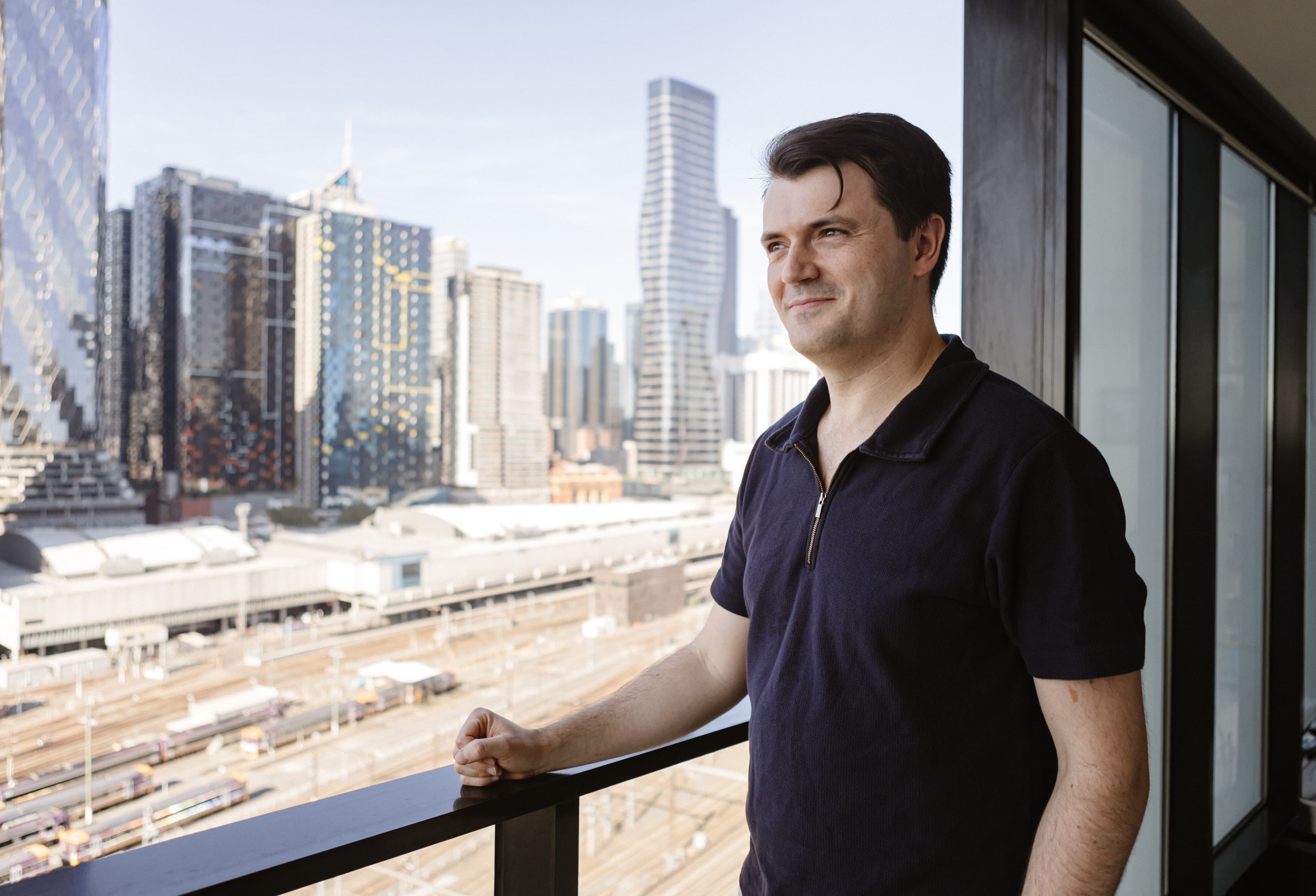
Nick (he/him), 29, Eastern Kulin Nation (Melbourne, Victoria)
Nick never expected to work in waste. He studied international relations, worked in hospitality, and helped build artificial wave pools. The pull came later as he watched his father, a veterinarian who refused to look away from the world’s waste, turn an unlikely passion into a family vocation. “My dad brings business experience; I bring design and marketing. It’s a good mix of practical and new thinking.” Together they now lead the Australian arm of an international clean tech company seeking to solve a waste crisis growing as quickly as the population. Their focus is transforming biosolids, what every human leaves behind each day, into usable resources, a process far removed from most Australians’ daily awareness.
Nick has come to realise that Australia’s waste system depends on that distance. “We’ve built a whole system designed to hide waste,” he explains. “It’s too easy for us to forget about our waste.” Waste disappears down pipes, into trucks, and behind industrial fences. Public attention fades with it. “When you can’t see something, you stop caring about it,” Nick says. “Once it’s out of sight, out of mind, yet it still impacts our environment and the community down the street.” In policy circles, sustainability experts often speak to one another without widening the conversation to a broader audience. “We talk in our silos and think we’re being heard. Meanwhile, the gap between the conversations we need to have, and our behaviour widens each year.”
Inside that gap sits a policy environment shaped for familiar risks and familiar technologies. “We used to be a go-getter country,” Nick says. “Now we’re more of a hold off and wait.” Small innovators feel the effects most sharply. Pilot projects stretch on, support weakens, and discussions repeatedly return to the same question: whether the solution already operates somewhere overseas.
Nick refuses to lose faith. He sees a workforce searching for purpose, engineers drawn to resource recovery once they recognise how closely it connects to energy and sustainability, and families like his proving that innovation can span generations. “We focus on the bad,” he says, “but there is a lot of good work happening.”
Over time, Nick has come to believe the barrier is less about technology than permission: the signals that determine when innovators can scale and when risks remain contained often remain unclear. Without clear signals, waste returns to the ground as methane and microplastics, markets fail to form, and domestic capacity weakens. The consequences rarely stay hidden. As Nick puts it, even when waste disappears from view, “it still impacts our environment and the community down the street.” With the right architecture, waste becomes a resource, businesses scale, and talent stays onshore.
"Some people say we can educate our way out of this, others say we can technology our way out, I think we need both," Nick says. Australia has the ideas and talent. What it needs is a system willing to move at the pace, and with the urgency, that the problem demands.


The policy trajectory of Australia’s waste system
Nick’s story describes a waste system designed to remove materials rather than retain their value. Once disposed of, materials leave domestic production cycles, weakening incentives for recovery, reinvestment, and downstream accountability. Regulatory and commercial settings still make disposal the simplest and lowest-risk option, even as waste streams grow in volume and technical complexity. Recovery and onshore processing face higher costs, uncertain demand, and fragmented policy support, which limits their ability to scale. Innovation slows and Australia’s economic leverage over material flows weakens. Environmental, fiscal, and strategic costs shift forward, leaving fewer tools to manage materials within the national economy.
The potential of future generations policy to intervene
A future generations policy approach redesigns waste governance around long-term stewardship of material value. Durable standards, aligned regulation, and stable investment signals for domestic processing would reshape the incentives that guide material flows. Waste streams could function as reliable inputs for circular industries, supporting skills development, anchoring capital, and strengthening industrial capability onshore. This direction preserves economic opportunity while reducing the environmental and financial liabilities passed to future Australians.
Policy landscape
Today's policy landscape: Australia's waste management landscape
Australia’s waste regulations were originally designed to protect public health risk and manage disposal. They remain oriented toward containing harm instead of recovering material value. Approval processes for waste-to-resource infrastructure are often lengthy and complex, deterring investment and slowing the development of new facilities. For innovators like Nick, this means extended pilot phases, uncertain investment horizons, and persistent difficulty moving from demonstration to commercial scale.
These constraints reflect a broader structural feature of the system. Wastewater and biosolids governance has historically operated with limited public engagement, with public visibility and scrutiny only increasing more recently. This context has contributed to slower institutional adaptation and evolving regulatory expectations. In practice, the deployment of recovery technologies can be slowed by approval processes and evolving policy frameworks. Some states have begun investing in advanced biosolids and wastewater treatment facilities, yet adoption remains slow and uneven without clearer national direction or incentives.
Australia currently operates 5,509 waste and resource recovery facilities, including 1,272 landfills. Despite this scale, the system remains organised around disposal rather than long-term resource management. Modelling shows that Greater Sydney’s landfills could reach capacity by 2030, pushing waste to regional and interstate sites. This shift would increase transport emissions, raise costs for councils and households, and transfer environmental burden onto regional communities.
Different states are experimenting with alternative approaches. Western Australia has invested in waste-to-energy (WtE) facilities that generate electricity by burning residual waste, with ash reused in construction materials. Similar facilities have operated in Europe for decades. However, evidence from countries such as Denmark shows that large WtE capacity can discourage resource recovery by creating constant demand for feedstock. In response, Denmark has begun importing waste from abroad to maintain plant utilisation, raising concerns that disposal infrastructure can undermine circular economy goals.
Past policy decisions continue to shape present investment patterns. Landfill expansion and waste transport remain the lowest-risk options under existing regulatory and financial settings. Recovery infrastructure struggles to attract capital at scale, reinforcing a system that favours disposal even as landfill capacity tightens.
At the same time, new waste streams are expanding rapidly. Solar panels, batteries, and electronic waste are increasing faster than processing infrastructure can be built. Several states have banned solar panels from landfill, yet national recycling infrastructure remains insufficient to handle the growing volume. Compliance requirements therefore advance ahead of market readiness, shifting operational and financial risk onto waste operators and technology developers.
National policy signals an ambition to move toward circularity and domestic resource recovery, but governance remains fragmented. States regulate waste systems independently, standards vary across jurisdictions, and market signals remain inconsistent. New South Wales introduced the Plastic Reduction and Circular Economy Act (2021), commonly known as the single-use plastics ban, while other states have introduced similar measures with different scopes and timelines. This patchwork approach creates uncertainty for innovators and investors.
The result is a widening gap between ambition and alignment. Innovators invest against shifting regulatory signals and uneven demand. Smaller and regional enterprises face greater barriers to scaling new solutions, while large incumbents are better positioned to absorb compliance risk. Without stronger coordination, Australia’s emerging circular economy risks becoming narrower, less competitive, and less inclusive than its potential.
The value of a future generations approach
Australia’s waste system holds untapped economic and industrial value. Every waste stream represents a steady flow of materials that could support domestic manufacturing, skilled employment, and long-term investment. Yet current policy settings treat waste primarily as a disposal problem. Regulation and market incentives favour rapid removal and cost minimisation, weakening incentives to recover materials and manage them across their full life cycle.
A future generations policy approach treats waste as long-term economic infrastructure. Aligning regulation, standards, and public investment with material lifespans would give firms clearer signals to plan, finance, and scale domestic recovery and processing capacity. Predictable recovery pathways allow waste streams to function as reliable inputs for energy generation, construction materials, agriculture, and advanced manufacturing rather than residuals destined for landfill or export.
International experience shows what sustained policy alignment can achieve. In Taiwan, coordinated pricing, collection systems, and processing standards transformed the country from “Garbage Island” into a globally competitive recycling and recovery industry. In Denmark’s Kalundborg’s industrial area, firms exchange waste heat, water, and by-products as routine production inputs, embedding circular practices into everyday operations rather than relying on short-term pilot projects.
Future Generations Policy Analysis
A future generations policy lens focuses attention on the infrastructure and incentives that determine where material value is retained or lost, and highlights where intervention can still preserve domestic control over material flows. Consistent alignment across regulation, investment, and national coordination can redirect those flows before structural limits take hold. The choices made now will shape whether future Australians inherit deferred environmental liabilities or a resilient circular economy supported by domestic industry, skilled workforces, and stable recovery systems.
Case Study: Waste Reduction and Recycling Act 2021 (Victoria)
Victoria’s Waste Reduction and Recycling Act 2021 is one of Australia’s most significant attempts to shift waste policy from disposal toward material recovery and circular markets. The legislation introduced system-wide targets, standardised household recycling collections, and the establishment of Recycling Victoria to coordinate reform. It also included funding to support business innovation and investment in new recovery infrastructure.
Recent policy changes have altered this institutional architecture. Following recommendations from the Silver Review on regulatory efficiency, the Victorian government announced that Recycling Victoria will be absorbed into the Environmental Protection Authority (EPA) as part of a broader economic reform agenda aimed at reducing the number of business regulators. Other bodies, including Sustainability Victoria, are also being phased out under the same restructuring.
These reforms aim to improve coordination and planning certainty within Victoria, which can support investment in processing infrastructure, product development, and workforce capability. However, national fragmentation remains a constraint. Waste standards, regulatory requirements, and market signals still vary across states, reflecting the decentralised structure of Australia’s waste governance system and creating challenges for nationally coordinated circular economy markets.
The Act has also drawn criticism for focusing primarily on downstream waste management. While circular economy frameworks typically include upstream measures such as product design standards and extended producer responsibility, these elements receive limited attention in the legislation. As a result, the Act improves coordination and recovery capacity but leaves many of the structural incentives shaping production and waste generation largely unchanged.
Fairness dimensions
Life stage equity
By embedding circular economy objectives in statutory institutions and system-wide targets, the Act stabilises capability pipelines across time rather than relying on episodic programs, which allows skills, regulatory learning, and institutional memory to be carried forward instead of resetting with each investment cycle.
Distribution Across and Within Generations
The Act redirects value creation toward domestic processing and innovation, yet uneven access to scale, capital, and approvals risks concentrating benefits among larger incumbents, shaping future circular markets that are narrower and less competitive than broad-based participation would allow.
Future Opportunities and Path Dependency
Legislating long-horizon circular objectives shifts expectations about infrastructure, materials, and market development, weakening default reliance on landfill and export pathways and expanding the option space that future governments inherit when responding to new waste streams and technologies. This flexibility narrows if waste-to-energy becomes a default end-point that locks in costly infrastructure and discourages higher-value recovery over time.
Proportionate and Justified Trade-offs
By encouraging investment ahead of mature markets and harmonised standards, the Act shifts uncertainty toward early-stage innovators and SMEs, with deferred costs likely to reappear later as public remediation, market consolidation, or missed domestic value capture.
Precautionary Approach
By intervening before landfill saturation and offshore dependency become irreversible, early coordination and investment reduce the likelihood that future governments inherit crisis-driven baselines requiring higher ongoing expenditure simply to maintain system function.
Our opportunity to shape Australia’s future
Within Australia’s waste system, the intergenerational risk extends beyond rising volumes to the gradual loss of economic and governance control over material flows. When policy settings favour rapid disposal instead of sustained recovery, markets fail to develop, skills pipelines weaken, and domestic processing capacity remains thin. Short-term decisions taken to manage immediate pressures can narrow future options and raise the cost of later intervention. By the time impacts become visible, regulatory, industrial, and investment constraints may already be embedded.
Two possible futures
A future of waste crisis
It’s 2040, and Australia's waste generation has nearly doubled. The country that once exported much of its waste now bears the full cost of decades of ‘bury-and-forget’ thinking.
Landfills have expanded into chains of capped mounds around major cities. Melbourne’s largest site has become a rising mass of buried plastics and organics, releasing heat and gas into the surrounding landscape. Instead of building innovation hubs, Australia spent years constructing emergency trenches, transport corridors, and temporary fixes that absorbed public funds without altering the system’s direction.
Many technologies designed for Australian conditions never progressed beyond pilot stages. Governments and industry waited for perfect solutions and, in their hesitation, delayed viable ones. International firms eventually acquired struggling startups and moved intellectual property offshore. Australia now imports expensive circular-economy technologies it once had the capability to develop and scale itself.
The economic toll is now evident. Waste management costs tens of billions each year, alongside rising environmental and public health impacts. Young engineers and entrepreneurs leave the sector in growing numbers, taking expertise and innovative capacity with them. Australia’s reputation has shifted from the “lucky country” to the “wasteful country,” defined by lost opportunity. None of this came as a surprise. The warning signs were visible for years, yet delay became the default response.
A future of circular innovation
It's 2040, and Nick's younger cousin stands on the grounds of what used to be Melbourne's largest landfill. The heat that once rose from buried waste has disappeared. In its place stands the Asia-Pacific Circular Economy Innovation Hub, a broad campus where emerging technologies are tested, refined, and deployed into modular waste-to-resources systems serving cities and regional communities. What was once a monument to disposal has become a centre of regeneration.
The shift began when Australia stopped treating waste as something to hide and started treating it as material to manage deliberately. Policy, investment, and industry moved in the same direction. Landfills were gradually phased down through clear national pathways, while recovery infrastructure expanded across states. Technologies that once stalled at pilot stage finally moved to scale.
Companies like Nick’s played a central role. Years spent working with biosolids and industrial by-products became valuable expertise as the system reorganised around recovery. The workforce evolved alongside it. Engineers became materials stewards, waste operators became resource technicians, and new careers emerged in circular manufacturing, advanced recycling, and materials redesign.
Regional cooperation followed. Australia helped establish Indo-Pacific platforms for workforce exchange, research, and technology deployment, accelerating circular solutions across neighbouring countries. Former landfill sites were transformed into renewable energy facilities, resource-recovery parks, and urban agriculture hubs. Materials that once leaked into oceans or settled underground now circulate through domestic industries.
By 2040, the system functions differently. Waste streams operate as reliable inputs for manufacturing, energy, and construction rather than residuals destined for burial. Reliance on landfill has dropped sharply. Circular industries anchor skilled employment and attract investment, while small and medium enterprises drive innovation across the sector. What began as a response to mounting waste pressure has become a defining feature of Australia’s economic resilience.


Go deeper