
Portrait 04 of 15
Zen
Aligning Disaster Governance with Local Intelligence
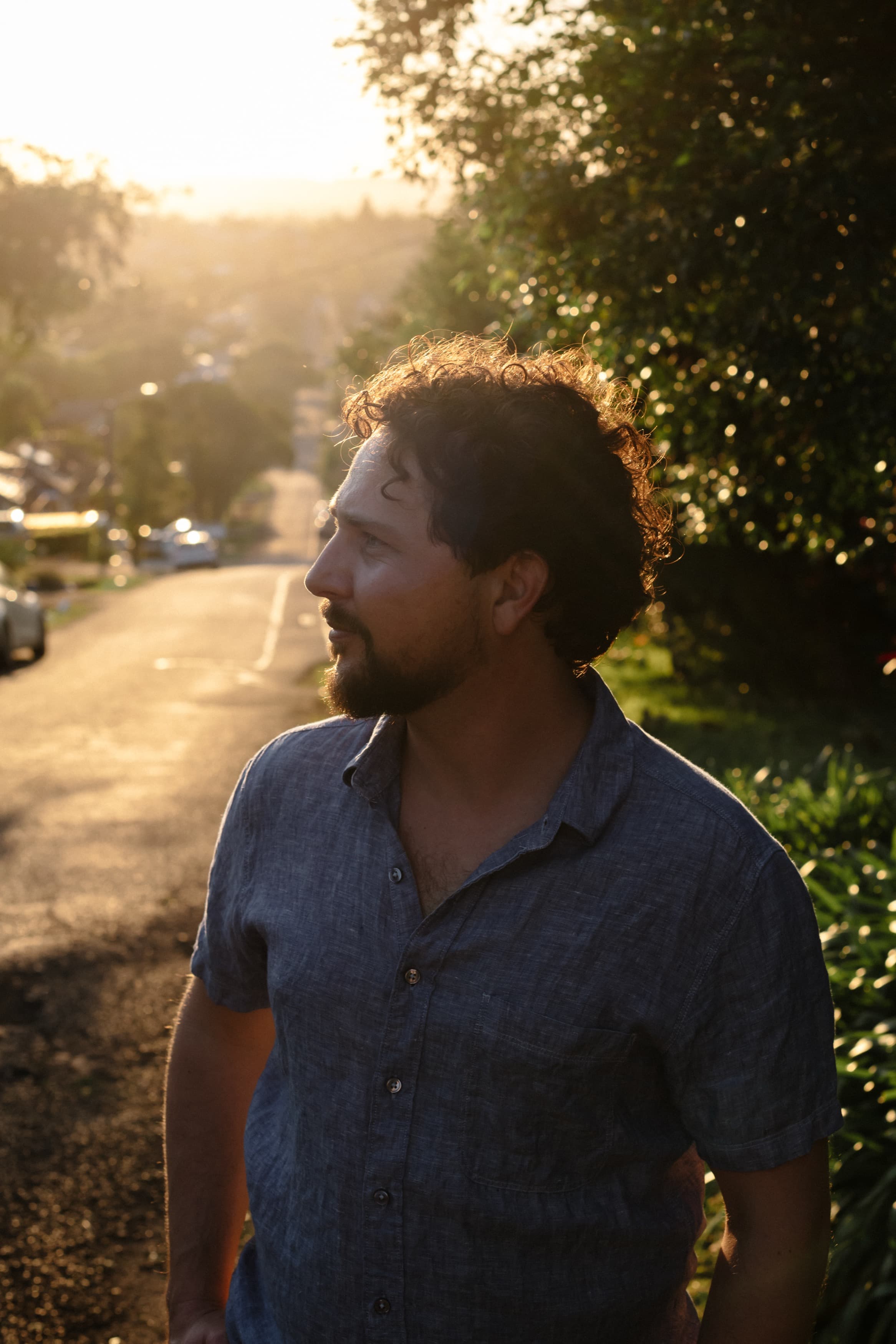
he/him · 39 · Bundjalung Country (Lismore), NSW
Disaster management · Climate resilience
Communities learn from every flood. Institutions keep starting from scratch.
When the 2022 Northern Rivers floods peaked at 14.5 metres, government alerts arrived too late and neighbours became the first responders. Zen, a mental health practitioner who has lived through two major floods, describes a community that has built sophisticated shadow governance - local knowledge, informal networks, rapid response - while formal systems reset after each disaster and fail to absorb what communities already know.
Through Zen’s eyes
Zen (he/him), 39 | Bundjalung Country (Lismore, New South Wales)
Zen has lived in Lismore for eight years, long enough to see how a community adapts when institutions cannot keep pace with the realities they face. When floodwaters reached 14.5 metres, his second-floor practice, once assumed to be safely above the flood line, was inundated. Government alerts arrived “too late after days of heavy rain,” he recalls, so “the community had to be the responders.”
Having lived through both the 2017 and 2022 floods, Zen has watched Lismore develop what he calls a parallel system of “shadow governance”: informal yet highly capable networks built on rich local knowledge that mobilise faster than formal systems. People turned to one another first because outside assistance often arrives after the crucial hours have passed. These networks coordinate rescues, share hyper-local information, move supplies across town, and adjust services long before official channels come to life. Schools shift classrooms without waiting for approval. Businesses install their own power. Mental health practitioners like Zen move immediately into outreach and telehealth. It is expertise shaped by repeated disruption, yet much of it remains largely invisible in policy discussions.
Zen plans ahead in every way he can. He bought a home in a low-risk zone and closely tracks policy changes to understand “what I can have some control over.” The emotional toll, however, is constant. Resilience without change leaves people trapped in the same cycle. “It’s a love-hate relationship with Lismore. You do become a bit numb, but it's scary,” he says. He has also learned the longer rhythm of recovery. “It takes about three years after a big flood to bring in new energy and creativity.” Communities heal, but on timelines formal systems rarely recognise or prepare for.
Lismore’s experience sends a clear signal: when official systems lag behind lived reality, communities build the governance they need. Zen’s story shows that people who face repeated climate impacts hold practical knowledge about what actually works. Recognising that intelligence means “shifting power, resources, and decision-making into the hands of the communities closest to the issues.” As Zen puts it simply: “When frontline communities lead, we move from short-term fixes to long-term solutions rooted in place, wisdom, and lived experience.”

The policy trajectory of disaster governance
Zen’s story reveals a disaster governance system designed for isolated emergencies rather than sustained climatic pressure. Current policy frameworks prioritise post-event response and short-term cost control, even as hazards strike more frequently and recovery periods overlap. Communities build practical knowledge through repeated exposure, yet institutional processes restart after each event, preventing lessons from carrying forward and slowing recovery. The result is mounting pressure on local capacity and rising long-term costs as hazards recur without corresponding changes in system design. Future Australians face greater exposure while governance structures struggle to retain experience or anticipate cascading impacts.
The potential of future generations policy to intervene
A future generations policy lens reframes disaster governance around cumulative risk and longer recovery horizons. It shifts attention toward prevention, knowledge retention, and continuity across events. Stronger investment in these areas strengthens institutional learning and improves decision-making over time. It also allows local expertise to shape system design and helps governance structures remain responsive as climate volatility intensifies, increasing the likelihood that future generations inherit disaster management systems capable of responding effectively to repeated shocks.
Policy landscape
Today’s policy landscape: Australia’s disaster governance
Australia’s disaster management approach was largely designed for rare, short-lived, and geographically contained emergencies. Today, disasters arrive back-to-back and overlap, exposing institutions built for a different era. The 2022 Northern Rivers floods illustrate this shift. Two major floods struck within weeks, peaking at 14.4 and 11.4 metres. 37 homes were destroyed, more than 1,400 were severely damaged, and 18,000 livelihoods across 3,170 businesses were disrupted. Economic losses exceeded AUD 400 million, but the material damage was only the beginning.
Insurance failures quickly became a second crisis. Only 34% of surveyed households were insured. High premiums and “uninsurable” classifications pushed many families out of coverage entirely. Delayed and inconsistent claims deepened financial strain and institutional distrust, prompting federal scrutiny. At the same time, climate-driven hazards now overlap across the country, turning acute shocks into chronic disruption. Annual declarations of major disasters exceed totals once recorded across entire decades in the 1970s. Systems face repeated shocks with little time to recover, learn, or adapt. In places such as Lismore, recovery has blurred into a continuous cycle of response and adaptation, stretching agencies and eroding workforce capacity.
Despite these changes, core governance settings remain anchored to command-and-control models and short-term relief mechanisms such as the Disaster Recovery Payment (DRP) and Disaster Recovery Allowance (DRA). These tools were designed for isolated events, not sustained climatic disruption. Fragmented authority, coordination failures, and unresolved trade-offs persist, echoing findings from the 2020 Royal Commission. Australia’s disaster governance still prioritises response over ongoing risk reduction, leaving communities to operate in a riskscape far more continuous and complex than the system was designed to manage.
The strain is particularly visible in the disaster-response workforce. Frontline workers must support traumatised communities while managing their own losses. In northern New South Wales, health and social-service providers report rising burnout and turnover as damaged workplaces, disrupted records, and fractured professional networks undermine service continuity. Local vulnerability intensifies demand. Many practitioners rebuild their own lives while continuing to support others. The burden often falls even harder on private practitioners working outside coordinated service networks, where referral pathways and structural support remain weak.
Government responses have introduced targeted initiatives such as the National Disaster Mental Health and Wellbeing Framework (2024), NSW Recovery Services Capacity Grants, and volunteer coordination programs. These measures strengthen short-term operational support but remain time-limited and offer few pathways for workforce renewal, institutional learning, or flexible service delivery in regions facing repeated disasters.
Some policy innovation is emerging. In 2024, the Australian government, the NSW state government, and several local councils, including Lismore, reached a tripartite agreement to fund the restoration of roads and bridges damaged during the 2022 floods. The arrangement provides recovery funding upfront rather than requiring councils to finance repairs and seek reimbursement later. This change removes significant financial pressure from local government and accelerates infrastructure recovery. Although focused on infrastructure, the model signals how funding design could better support community recovery and resilience.
Meanwhile, communities continue to develop their own capabilities. During the 2022 floods, residents built early-warning systems, mapped evacuation routes, and established support hubs before formal response channels mobilised. In Byron Shire, community resilience groups organised local mapping, communication trees, and resource distribution networks in real time. Some of these efforts have since evolved into more structured initiatives, including Resilient Lismore and the Living Lab Northern Rivers, which connect community knowledge with researchers and government partners to develop adaptive strategies.
Yet these gains remain fragile. Without formal mechanisms to retain and integrate community knowledge between disasters, lessons fade as emergencies recede, volunteers burn out, and institutional memory resets. Bridging the gap between community capability and government practice requires governance models that treat local expertise as a core component of disaster management and build genuine partnerships between response agencies and affected communities.


The value of a future generations approach
Australia’s disaster system was built for discrete emergencies, not recurrent and overlapping hazards. When governments rebuild recovery arrangements after each disaster, institutional knowledge fades, specialist workforces shrink, and planning remains focused on response. Short-term assistance can stabilise communities for a time, but exposure and vulnerability may continue to rise. Local communities adapt through lived experience, yet formal systems struggle to carry lessons forward between events. Recovery stretches longer, fiscal costs rise, and households face higher risk with less reliable institutional support.
A future generations approach redesigns disaster governance around continuity. Policy captures operational experience and embeds it into future planning and investment decisions. Local and First Nations knowledge of Country informs risk reduction strategies, and frontline expertise remains active between disasters. Systems retain knowledge, capability, and local expertise between events instead of rebuilding them after each disaster. This reduces the financial and operational cost of repeated recovery while strengthening readiness over time.
International experience shows how this shift can work. The Netherlands’ Room for the River program integrates community knowledge into long-term land-use and flood management, reducing risk while strengthening institutional learning over decades. In Costa Rica, local emergency committees operate within the national disaster coordination system, allowing preparedness, trust, and operational capability to grow between events. Both models organise disaster governance in ways that prioritise retained capability between disasters, ensuring future generations inherit systems that do not need to rebuild after every emergency.
Future Generations Policy Analysis
A future generations policy lens brings the leverage point into focus: durability. Aligning disaster governance with longer recovery horizons, while retaining workforce capability and locally grounded intelligence between events, can shift the system away from repeated reconstruction and toward sustained preparedness.
Case Study: Australia's National Emergency Management Agency (NEMA)
Australia’s federal disaster recovery system centres on short-term financial relief coordinated by the National Emergency Management Agency (NEMA) under the Australian Government Crisis Management Framework (2024). NEMA oversees national coordination through the Disaster Response Plan (COMDISPLAN), while state and local governments deliver response and recovery on the ground.
The main federal stabilisation measures are:
Disaster Recovery Allowance (DRA): up to 13 weeks of income support for people who lose income following a declared disaster.
Disaster Recovery Payment (DRP): a one-off payment of AUD 1,000 per adult and AUD 400 per child for those most severely affected.
These mechanisms provide rapid financial relief after individual events and act as short-term shock absorbers. However, they are designed for discrete disasters rather than repeated and overlapping events. In communities such as Lismore, where response and recovery now blur into a continuous cycle, the system remains largely reactive and event-bounded.
Federal recovery arrangements therefore stabilise households in the short term but do little to retain workforce capability, embed community knowledge, or reduce exposure before the next disaster. Much of the practical recovery work instead falls to place-based organisations with deep local knowledge and trust, such as Resilient Lismore. Without formal mechanisms to recognise and support this capacity, it dissipates between events, leaving communities to rebuild both infrastructure and governance capability each time disaster strikes.
Fairness dimensions
Life stage equity
Recovery systems designed for short disruptions fail to protect key life transitions such as schooling, early career formation, housing security, and ageing. Repeated disasters interrupt these stages unevenly, allowing disadvantage to compound across the life course and generations..
Distribution Across and Within Generations
Event-based recovery concentrates repeated loss in high-risk regions, passing forward geographic inequalities in safety, insurability, mental health burden, and economic opportunity. Where people can live, work, and raise families becomes increasingly shaped by inherited exposure rather than choice.
Future Opportunities and Path Dependency
Recovery systems that reset after each disaster prevent institutional learning and workforce continuity, locking governance into reactive modes and leaving future governments with higher baseline risk and fewer options to reduce harm and exposure.
Proportionate and Justified Trade-offs
Prioritising rapid stabilisation over durable recovery trades short-term fiscal containment for long-term cost escalation, shifting uncounted recovery labour to households and communities and compounding social, economic, and budgetary liabilities.
Precautionary Approach
Failure to retain and act on local intelligence allows foreseeable risks to escalate. As thresholds are crossed through repeated displacement, workforce exit, and loss of insurability, future cohorts inherit exposure levels that no longer respond to incremental adjustment.
Our opportunity to shape Australia’s future
As climate-related shocks become more frequent and overlapping, systems that rebuild arrangements after each event pass higher exposure, weaker institutional memory, and reduced local capacity to the next cohort. Communities adapt through lived experience, but when formal systems fail to retain that learning, recovery slows and public costs rise.
Two possible futures
A future of institutional lag
It’s 2040, and the pattern Zen once described has become a permanent dysfunction. Communities have continued to build capability through repeated crises, while institutions remain slow, reactive, and fragmented. Delays, duplication, and short-term resets have become routine features of governance.
The consequences have reshaped where people can live. Skilled workers and families have left high-risk regions for places where insurance, planning systems, and mental health support do not leave them carrying disproportionate burdens. Those who remain live in a cycle where recovery never fully ends, absorbing the emotional and financial weight of systems that can no longer protect them. Services rebuild, then thin out again. Local organisations burn through volunteers as each disaster demands a new surge of unpaid labour.
Government support still arrives, but typically late and in fragments. Payments stabilise households briefly, then fade, while the longer work of rebuilding capability is left to communities. Each inquiry produces recommendations; each season reproduces familiar failures. Learning rarely holds because governance resets too quickly to retain it.
By 2040, the gap between capability and institutional authority has become a source of deep inequality. Some places can recover because their networks are strong enough to substitute for governance. Others face prolonged displacement and deeper loss because they lack that capacity. As hazards have become continuous pressures, the failure to embed local intelligence has become one of Australia’s most consequential missed opportunities. The country now stands more exposed, more uneven, and increasingly dependent on community heroism to compensate for institutional lag.
A future of distributed resilience
It’s 2040, and Zen trains a new generation of social workers in what is now known as the “Lismore Model”. What first emerged as improvised coordination during the 2017 and 2022 floods evolved into a durable way of working: community-led decision-making paired with responsive institutional support. The lessons travelled. Flood experience informed fire readiness in the south, while coastal adaptations shaped drought responses inland. Local knowledge became the starting point rather than the footnote.
The shift took hold when governments began treating local networks like Lismore’s as core operating capacity. Formal systems adapted, moving away from command-and-control toward supporting and amplifying the intelligence already present on the ground. Decision-making moved closer to communities, and support arrived early. Evacuation routes, communications protocols, and service delivery models were updated between seasons instead of being rediscovered during the next crisis. Workforce structures evolved as well. Social workers no longer had to choose between financial stability and serving high-risk communities. Funding models began to reflect the realities of frontline work: rapid adaptation, community partnership, and continuity of care.
By 2040, disasters still arrive, but far fewer communities wait for help that comes too late. Local intelligence guides decisions because it is embedded rather than consulted after the fact. Communities and formal institutions operate in sync instead of sequence. Recovery moves faster because capability remains in place, and prevention expands because planning horizons match the reality of ongoing risk. Trust holds because people can see that learning is retained, and that the system is designed to keep pace.


Go deeper