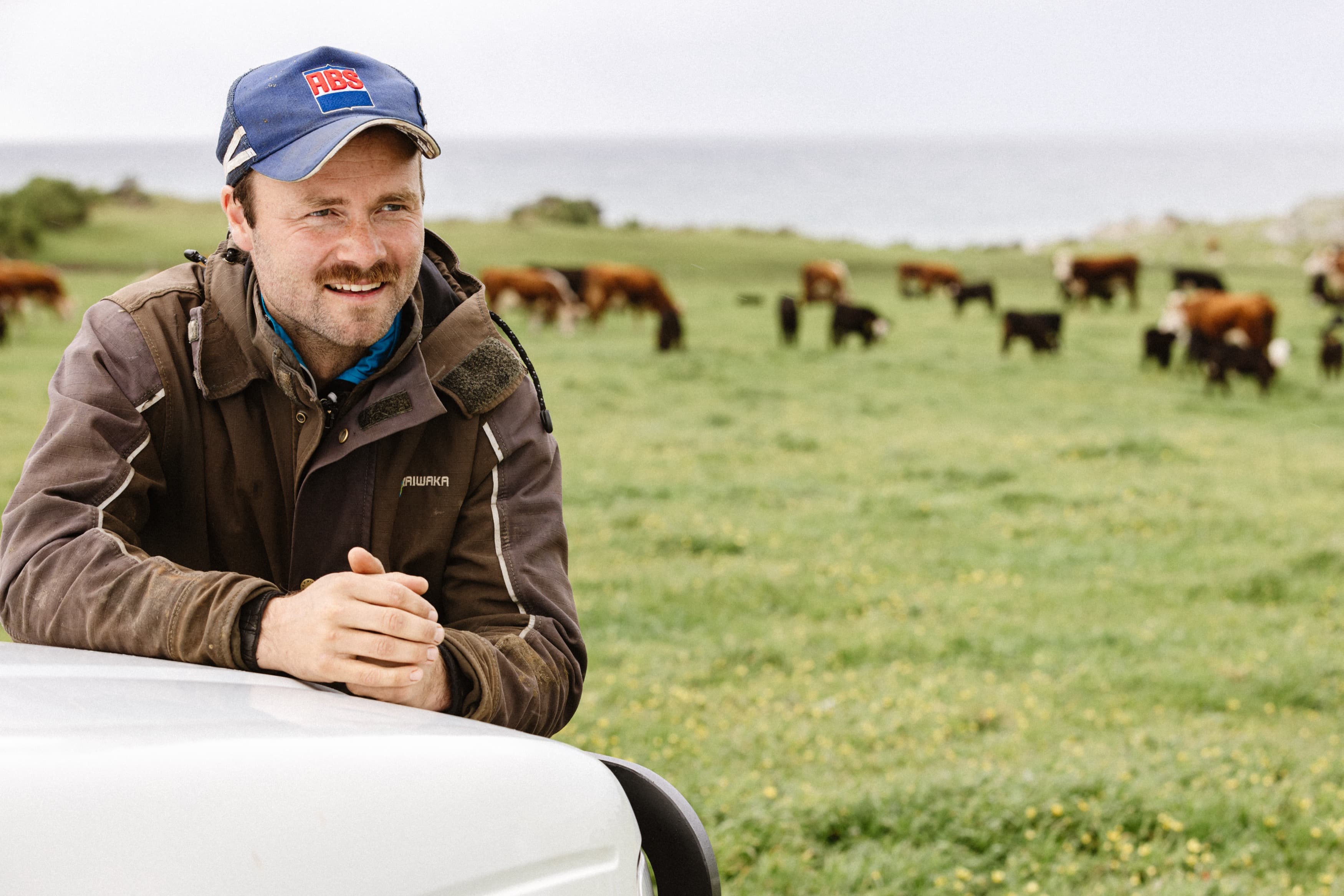
Portrait 02 of 15
Stafford
Agriculture Across Generations
he/him · 30 · Peerapper Country (Marrawah), TAS
Agriculture · Succession
So many ways to get out. So few ways to get in.
Stafford is a fourth-generation beef farmer in one of the most remote corners of Tasmania, raising his son on land his family has worked for over a century. Farm values have surged 220% since 1990 while the average beef farmer is now 62. Stafford’s story illuminates what happens when the policy cycles that govern agriculture are measured in years, but the decisions farming requires take decades.
Through Stafford’s eyes
Stafford (he/him), 30 | Peerapper Country (Marrawah, Tasmania)
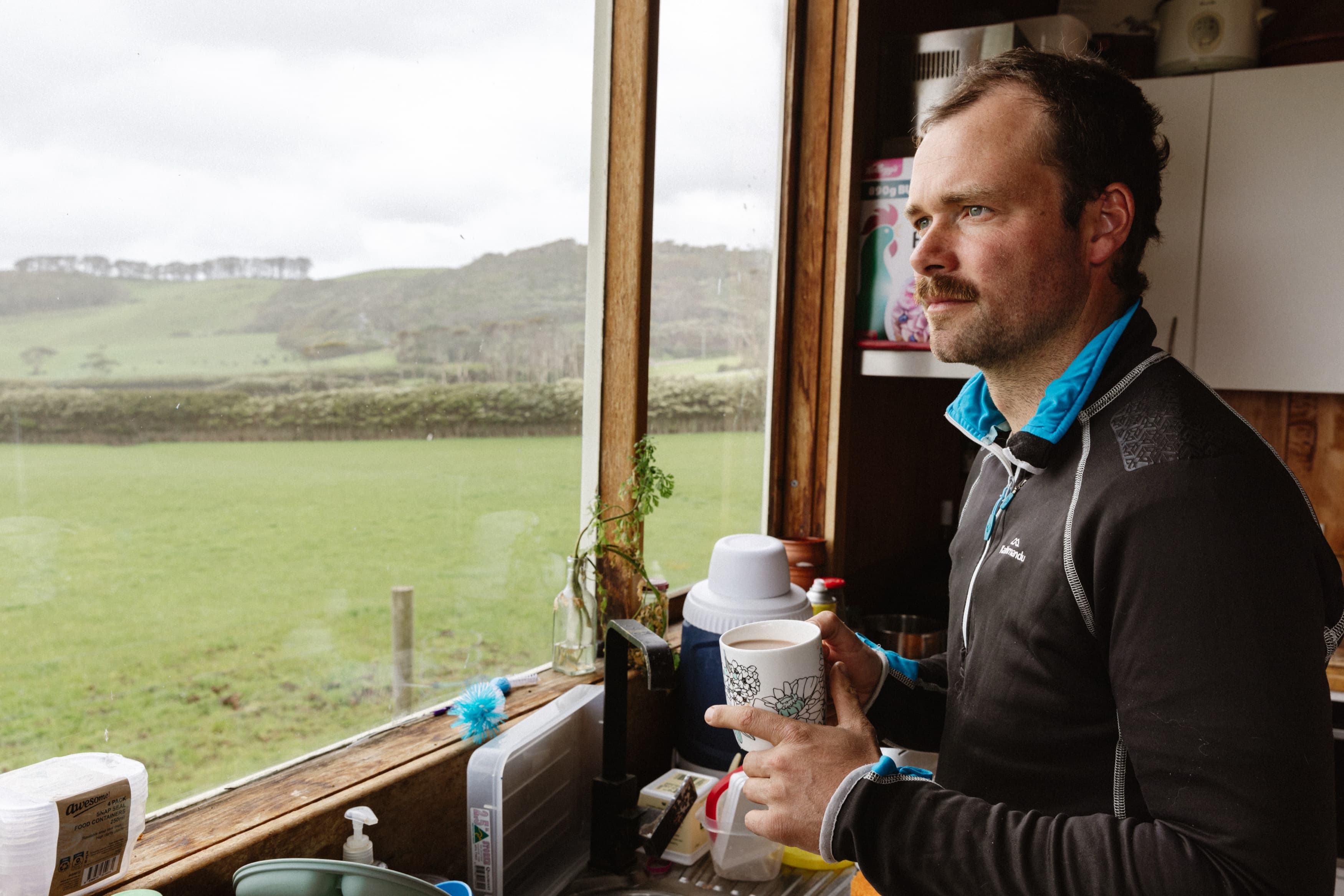
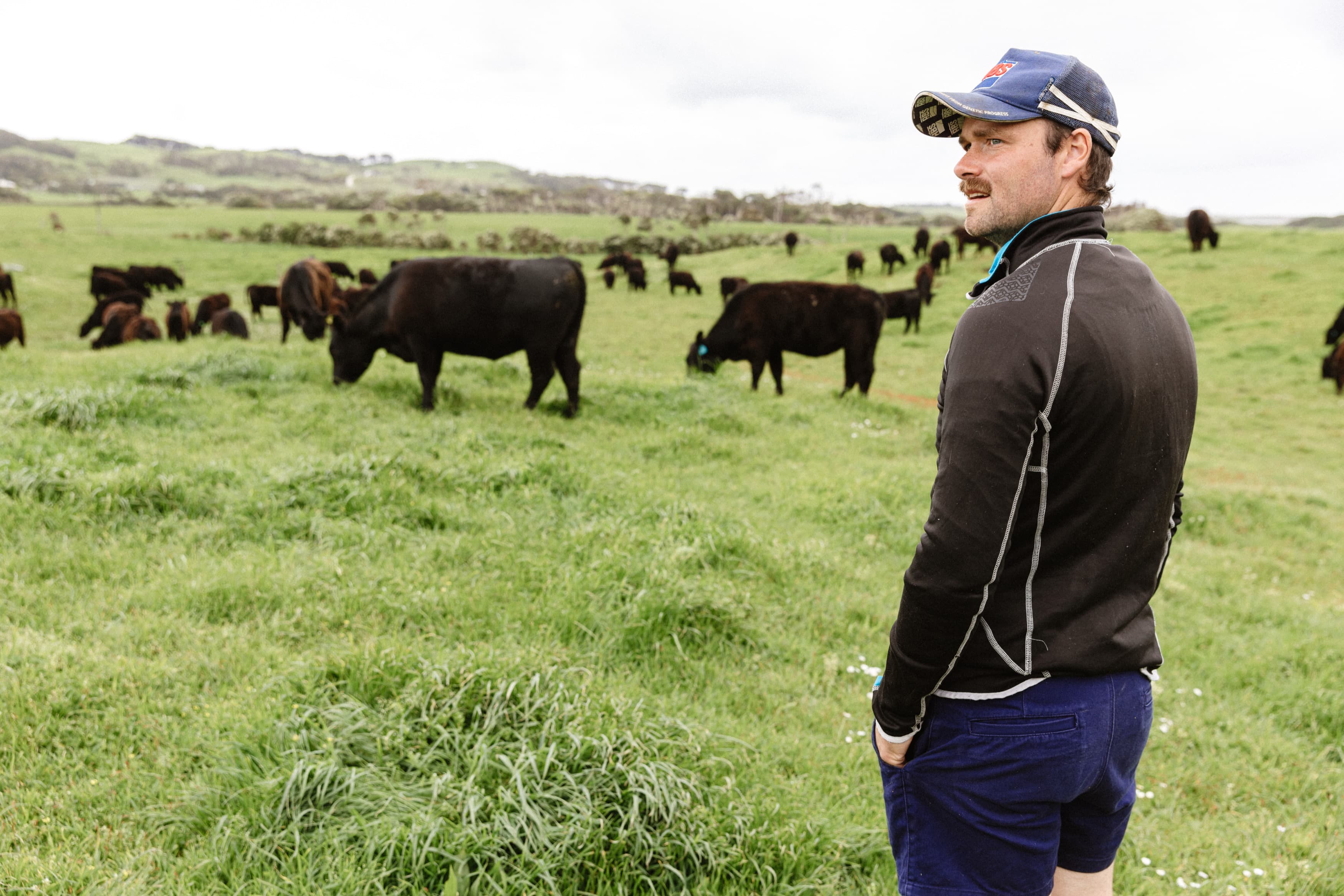
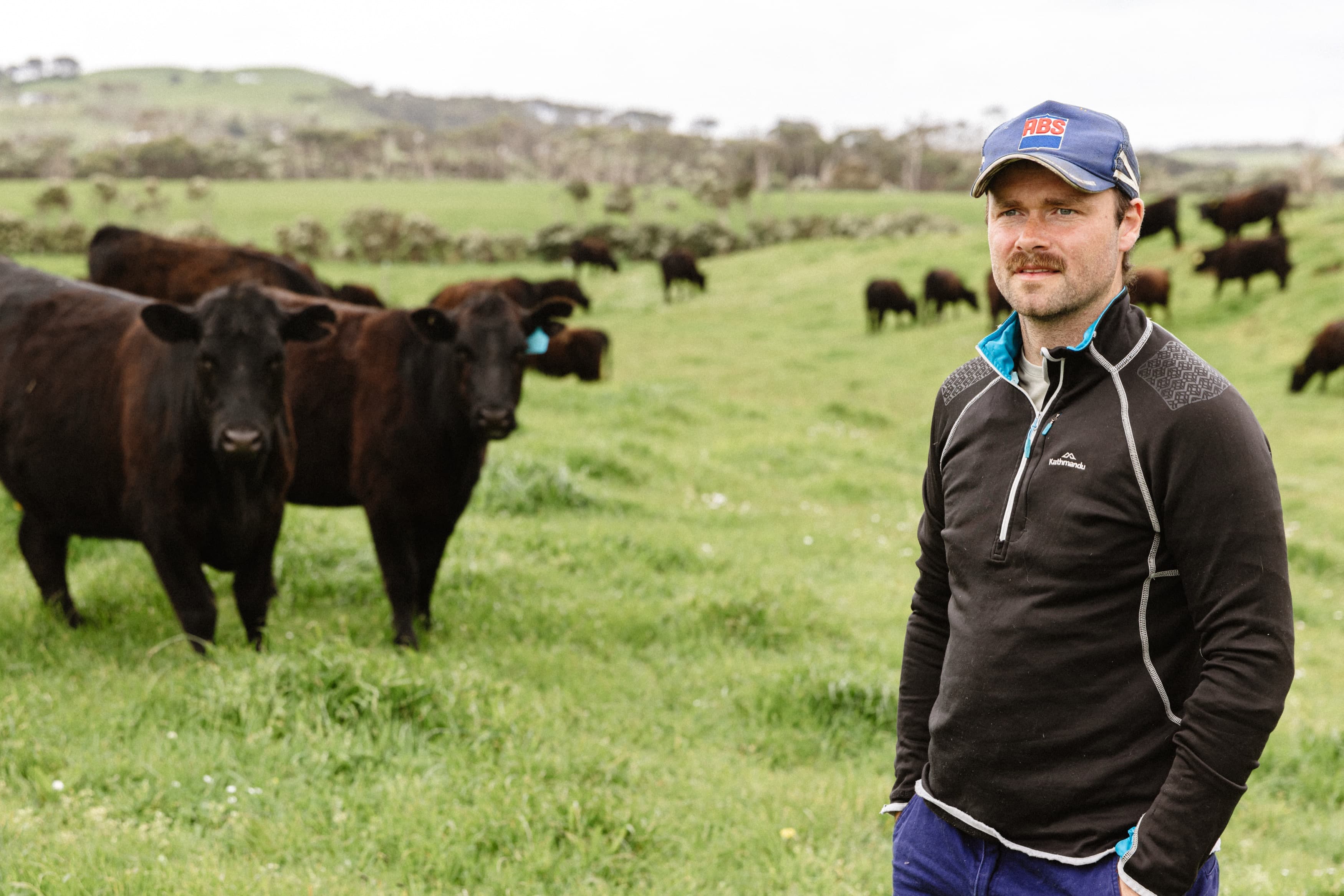
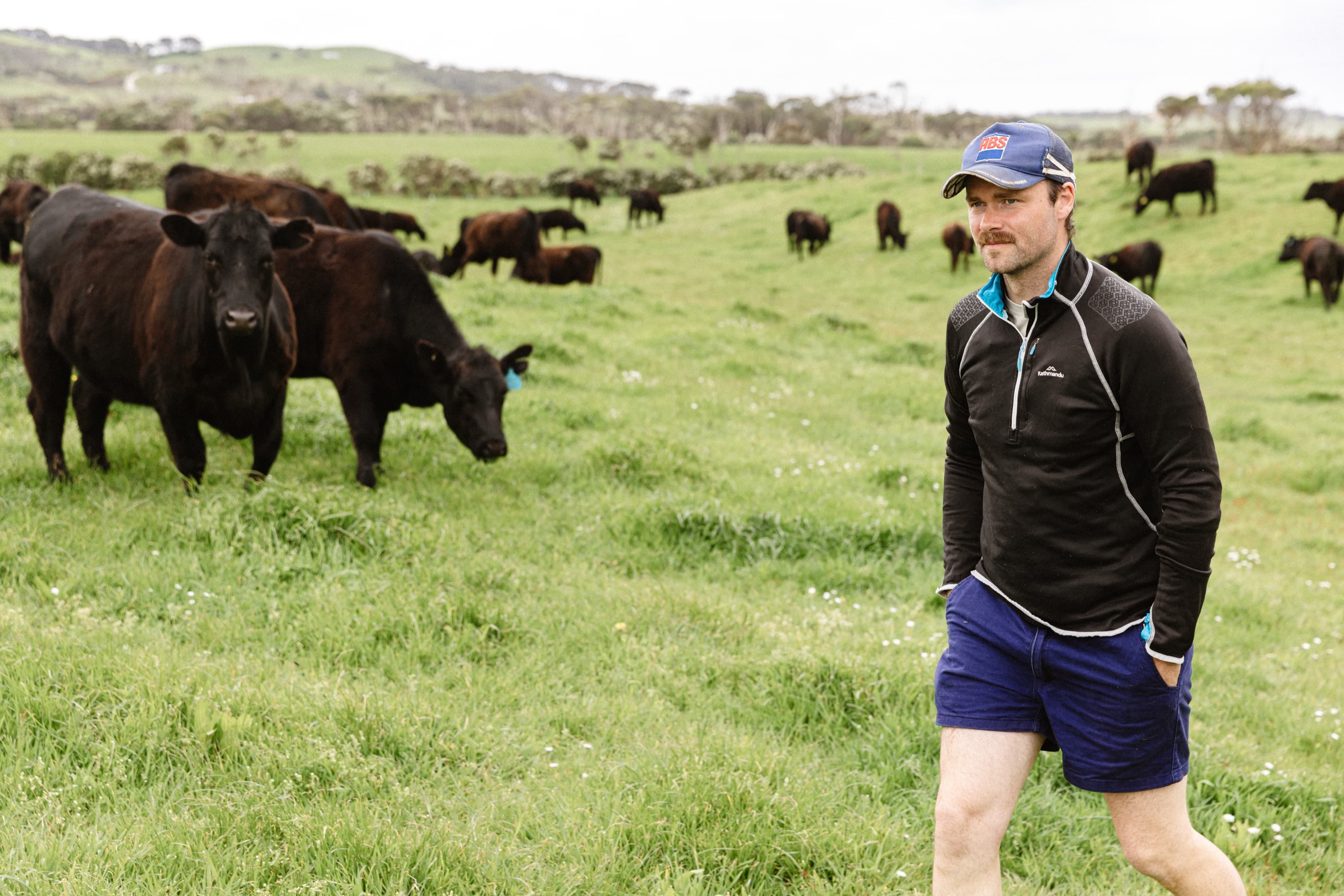
Stafford is a fourth-generation beef farmer in Marrawah, a village of 150 people near Cape Grim, a place he proudly describes as having “the cleanest air in the world”. He and his partner Christina, a large-animal veterinarian, are raising their 14-month-old son, named Oscar after Stafford’s great-grandfather, on the 200 hectares his family has tended for more than a century.
He is part of a shrinking minority: young farmers who stay. Where earlier generations assumed continuity, he now sees peers stepping away. Too many, he says, “have just given it up” and feel compelled to walk away as mounting pressures leave little room to remain. His family chose to act before fragmentation became inevitable, making deliberate decisions about how to keep the land intact, what legacy to preserve, and who would take on the responsibility. “If we were to split it up 25% each,” he explains, “the farm would be sold, and then it would be no longer.”
Succession planning within a family solves only one part of the challenge. Stafford knows that even the most deliberate internal decisions can falter in the face of external uncertainty. “Farmers are the best adapters,” he notes, “but you need to set the ground rules early so people can plan.” He sees the tension repeatedly: families plan across generations, while policy shifts from term to term.
The strain begins with a decades-long barrier to entry. “Farm ownership is, at a minimum, a 20-year slog,” Stafford explains. Agriculture is “asset-rich and cash-poor”: land values soar while cash flow lags, making even skilled young farmers “high-risk” in the eyes of banks. Credit dries up, and the doorway into farming narrows further. When the pressure builds, buyers step in. Corporate and foreign acquisitions pick up pace, and each sale sees knowledge that took generations to build slip away. Stafford summarises it plainly: “So many ways to get out and so few ways to get in.”
Gaining entry is only the beginning. Adaptation depends on planning horizons that run 10 or 20 years into the future. Infrastructure upgrades, breeding cycles, pasture renewal, and the slow work of managing the land cannot be improvised. Yet policy arrives with little warning, forcing long-term decisions into short-term reactions and pushing smaller operators to the edge. This dynamic feeds a growing divide between urban Australia and the people producing its food. Stafford is clear about the stakes: “If we put regions against cities, we all lose.”
What he carries is more than an enterprise; it represents a century of accumulated knowledge, responsibility, and care. Whether this inheritance endures depends on whether Australia builds the conditions to keep such legacies alive, or lets them slip quietly into the archives.

The policy trajectory of Australian agriculture
Stafford’s story exposes an agricultural system shaped by short policy cycles, volatile markets, and restricted entry pathways, even though farming operates on multi-decade horizons. Current settings prioritise near-term efficiency, output, and price responsiveness over long-term land stewardship and generational continuity. Rising land values, tighter credit conditions, and shifting program settings make it harder for new and mid-career farmers to enter the sector or plan succession. Production may continue, but the system’s capacity to manage cumulative ecological and financial risk is placed under strain. Australia risks sustaining output while undermining long-term resilience.
The potential of future generations policy to intervene
A future generations policy approach structures agricultural governance around the timeframes on which farming depends. It seeks to reduce uncertainty by providing stable policy signals, long-horizon investment frameworks, and structured support for land transfer and succession. These settings would strengthen continuity within farming regions and improve the sector’s ability to adapt to climatic and economic pressures. They would also improve the likelihood that future Australians inherit productive land, viable farming communities, and a resilient agricultural system.
Policy landscape
Today’s policy landscape: Australia’s agricultural ecosystem
Australia’s agricultural sector sits at the crossroads of two linked transitions: who will farm the land next, and whether those future farmers will have the stability required to adapt to climate change over decades. Policy often treats succession and adaptation as separate issues. In reality, they form a single system. Entry pathways, land ownership, credit access, and climate investment all interact to determine whether farming remains viable across generations.
Structural barriers to entry are narrowing the pipeline of new farmers. In New South Wales, farm values have increased by more than 220% since 1990, while the number of more affordable farms priced under AUD 500,000 has fallen by over half. Banks increasingly classify young farmers as high-risk borrowers, and without family land or equity, most are unable to enter the sector. At the same time, foreign ownership has reached 12.9%, and consolidation across processing and supply chains has reduced local buyers and services. Abattoir closures, including the shutdown of Bega’s Strathmerton plant, have extended transport distances, raised operating costs, and weakened rural economies.
These pressures are unfolding against a rapidly ageing farming population. The average beef farmer is now around 62 years old. The window for generational transfer is narrowing. Without viable entry and succession pathways, land and capital consolidate faster than knowledge and stewardship can be transferred. Production may continue, but regional continuity and adaptive capacity erode.
Climate change further compounds these structural risks. Agriculture generates approximately 18% of Australia’s emissions, and 92% of farmers report experiencing significant climate impacts in recent years. Yet policy settings continue to shift on short political cycles, misaligned with the 10 to 20-year timeframes required for infrastructure upgrades, breeding programs, water planning, and soil recovery. For farmers already facing insecure tenure or uncertain succession, this volatility discourages long-term adaptation investment.
International experience highlights the risks of misaligned intervention. In New Zealand, carbon incentives redirected more than 260,000 hectares of productive farmland into forestry for carbon credits, weakening rural economies and food production. Subsequent restrictions on farm-to-forest conversions reflect a hard lesson: climate policy must also protect long-term agricultural continuity instead of pursuing short-term emission gains in isolation.
The value of a future generations approach
Farming depends on generational continuity. When entry pathways narrow and policy signals fluctuate, that continuity weakens. Skills transfer slows, succession falters, and land ownership consolidates. Australia may retain productive land, but it risks shrinking the pool of people with the experience, capital, and institutional backing required to manage it. The result is greater strain on regional economies and declining adaptive capacity across the sector.
A future generations policy approach realigns governance with the timeframes farming demands. It anchors agricultural settings in policy stability, predictable signals, and long-horizon planning. This alignment strengthens succession pathways, supports earlier and more viable entry, and enables sustained investment in land stewardship, workforce development, and infrastructure. It replaces reactive adjustment with deliberate continuity. The next generation of farmers will operate in a sector undergoing structural transition. They will confront climate volatility, market shifts, and technological change simultaneously. Those equipped with stable policy conditions and evidence-based frameworks can adapt with confidence and build enterprises designed to endure.
International examples demonstrate that such reform is achievable. Ireland’s Land Mobility Service creates structured, long-term land access arrangements beyond direct family succession, strengthening continuity and skills transfer. In Denmark, long-term climate agreements lock in durable rules across electoral cycles, giving farmers the certainty required to commit capital and labour to multi-decade decisions.
Future Generations Policy Analysis
A Future Generations Policy lens on Australia’s Agricultural Innovation Agenda
Case Study: Australia’s Agricultural Innovation Agenda
Australia has set an ambitious target: Delivering Ag2030 aims to grow the agricultural sector to AUD 100 billion by 2030. The critical question is whether current innovation settings support the generational continuity required to achieve it. Despite investment, productivity growth has slowed significantly, declining from an average of 3.6% per year (1989–2005) to 0.6% in the 15 years to 2019-2020.
The National Agricultural Innovation Agenda promotes research and technological advancement, yet it remains insufficiently aligned with the long planning horizons that farming demands. Industry-led strategies such as the 2030 Roadmap identify a key gap: structured support for generational renewal and succession planning. Without integrating long-term workforce and land transfer considerations into innovation policy, current settings risk widening the divide between established operators and the emerging farmers needed to sustain the sector.
State-level initiatives, such as AgriVision 2050 and Tasmania’s Sustainable Agri-Food Plan, signal long-term intent yet alignment between these state strategies and national climate, land, and continuity policies remains limited. Meanwhile, consolidation in processing, withdrawal of regional services, and shifts in land ownership are reshaping rural economies faster than policy frameworks adapt, weakening the structural foundations on which innovation depends.
Fairness dimensions
Life stage equity
Short-horizon policy and finance settings interrupt early-career capability formation and stewardship transfer, locking in ageing participation profiles and weakening renewal pipelines across farming lifecycles.
Distribution Across and Within Generations
Risk exposure and adjustment capacity concentrate unevenly as scale and capital determine who can absorb volatility, passing forward unequal access to assets, markets, and decision-making power. Emerging investment in natural capital and diversified enterprises does, however, create new pathways for young farmers who can demonstrate resilience and stewardship capability.
Future Opportunities and Path Dependency
Decisions calibrated to short electoral and market cycles normalise incremental adaptation, creating land-use and ownership lock-ins that constrain future options within brittle production and regional configurations.
Proportionate and Justified Trade-offs
Transition costs are deferred rather than absorbed collectively, leaving future governments with narrower and more expensive intervention options.
Precautionary Approach
Anticipation focuses on physical and market risks while neglecting thresholds in succession and governance, passing forward systems that manage exposure instead of retaining preparedness.
Our opportunity to shape Australia’s future
Australia can choose a different path for its agricultural sector. It can align governance, investment signals, and climate frameworks with the long planning horizons on which farming depends. When policy treats agriculture as enduring civic infrastructure central to land stewardship, food security, and regional development, it strengthens skills formation, succession planning, and local capacity across generations. Continuity becomes the result of deliberate policy design instead of relying on individual resilience alone to sustain it.
A future generations approach forces policy to confront its time horizon. It tests whether current land, finance, climate, and succession settings strengthen or weaken generational transfer. These decisions determine who can enter farming, who can remain, and whether long-term adaptation investment proceeds with confidence. At stake is the nature of inheritance itself: will future farmers receive productive land alone, or land supported by skills, capital access, and stable institutions? Today’s policy design will shape that outcome.
The two speculative futures below, inspired by Stafford’s story, examine how Australia’s agricultural conditions could diverge by 2040 under current settings or under redesigned policy frameworks.
Two possible futures
A future of loss and consolidation
It’s 2040, and the farm Stafford's family held for more than a century has been sold to an international corporation. Across regions like Marrawah and Gunnedah, similar stories have unfolded. As older farmers retire without successors, land passes to distant owners.
Corporate management systems replace generational and Indigenous knowledge with uniform practices. These systems perform adequately in stable seasons but overlook Australia’s microclimates and long ecological rhythms. As a result, soil health declines, biodiversity thins, and droughts and fires hit harder, while recovery takes longer.
Policy continues to respond incrementally. Short-term measures help some operators survive another season, but without structural support for succession or long-term planning, entire regions grow more vulnerable. Local abattoirs close, and suppliers disappear. Knowledge networks dissolve as experienced farmers leave and younger ones never arrive. Productivity gains plateau, and research and development shift toward low-risk, short-term returns that favour scale over resilience. Australia continues to export food, largely to low-price markets, but the system is brittle. When shocks arrive, responses are expensive and reactive. More public money flows into recovery than would ever have been required to sustain continuity.
Australia has lost the landholders and, with them, the culture of care built across generations. By the time the absence was fully recognised, much of the knowledge that once connected land, people, and place had already slipped beyond easy recovery.
A future of adaptation and renewal
It’s 2040, and Oscar, fifteen, works beside his father on the same Marrawah land five generations have cared for. The turning point came years earlier, when Australia aligned agricultural policy with the multi-decade decisions that farming demands. Stable and durable settings replaced constant adjustment, allowing families like Stafford’s to plan with confidence.
With predictable rules in place, long-term investment resumed. Farmers upgraded water systems, redesigned breeding programs, and planned pasture renewal across cycles instead of seasons. Farms diversified beyond a single production line: mixed grazing integrates with native revegetation, on-farm energy generation, soil carbon projects, and value-added processing. Income no longer depends on a single commodity or market. Farming rewards patience again, and knowledge transfers steadily from one generation to the next.
Carbon policy evolves alongside production. Whole-farm accounting recognises the interaction between output, sequestration, and stewardship, rather than forcing single-use outcomes. Native vegetation corridors are restored alongside grazing land, strengthening biodiversity and drought resilience while generating stable revenue through environmental markets and stewardship payments. Integrated land-use models value complexity and long-term care, beyond quick returns.
Entry pathways reopened. Redesigned agri-loan schemes, land mobility arrangements, and cooperative ownership models enable young farmers without family land to enter the sector. Training in agritech, climate adaptation, and ecological restoration attracts a new cohort, combining innovation with inherited practice, while Indigenous co-management arrangements deepen land stewardship and anchor knowledge locally.
By 2040, consolidation pressure eases. Marrawah stabilises, then begins to grow. Local processing returns at smaller scales. Schools remain open. Oscar considers pursuing a degree in agricultural science, confident that when he returns home, the farm will still be a place where he can build a life.


Go deeper