
Portrait 10 of 15
Jamie
Honouring Communities through Energy Transitions
he/him · 53 · Gunaikurnai Country (Traralgon), VIC
Energy transition · Regional employment
He powered the country for decades. He wants to know it won’t move on without him.
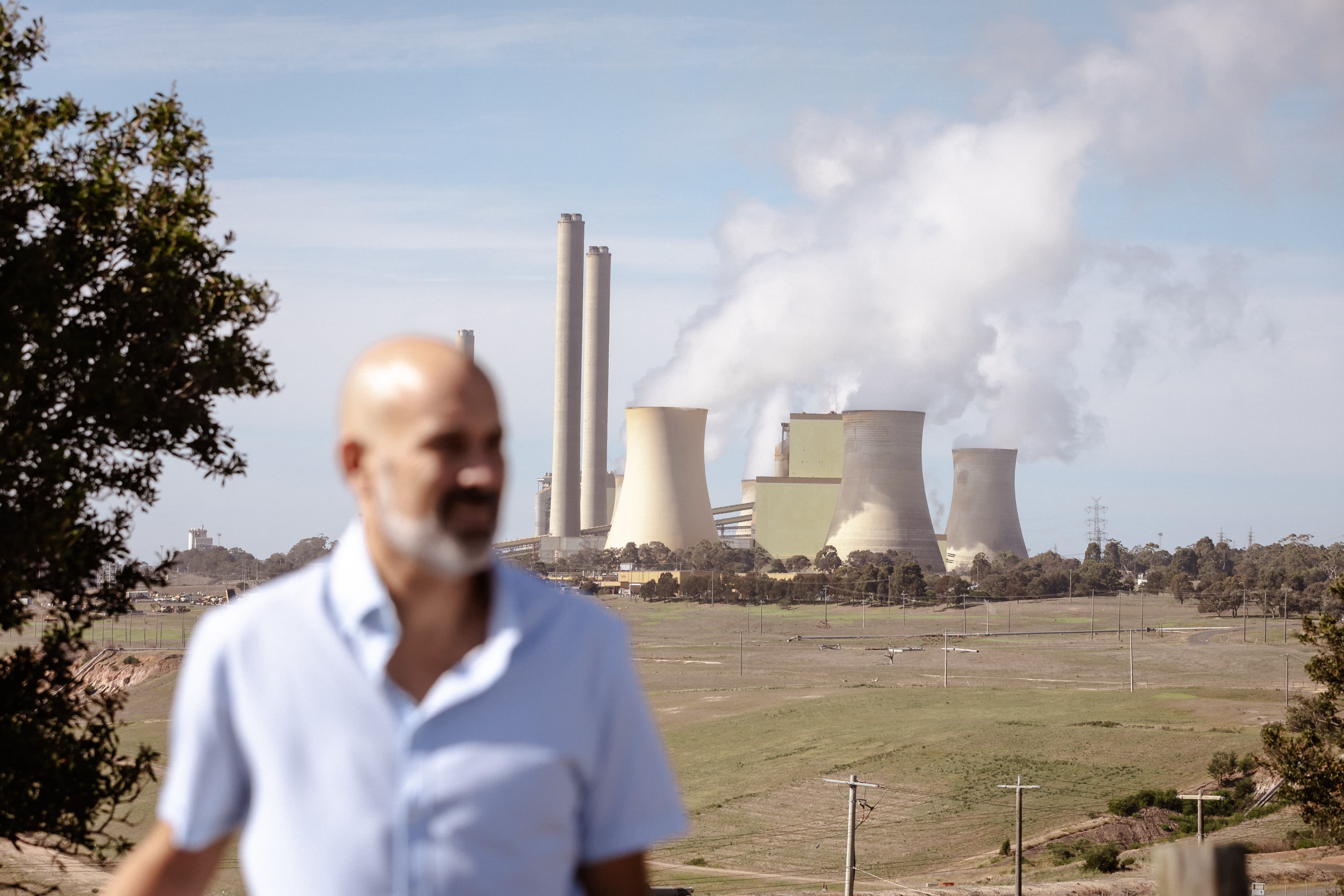
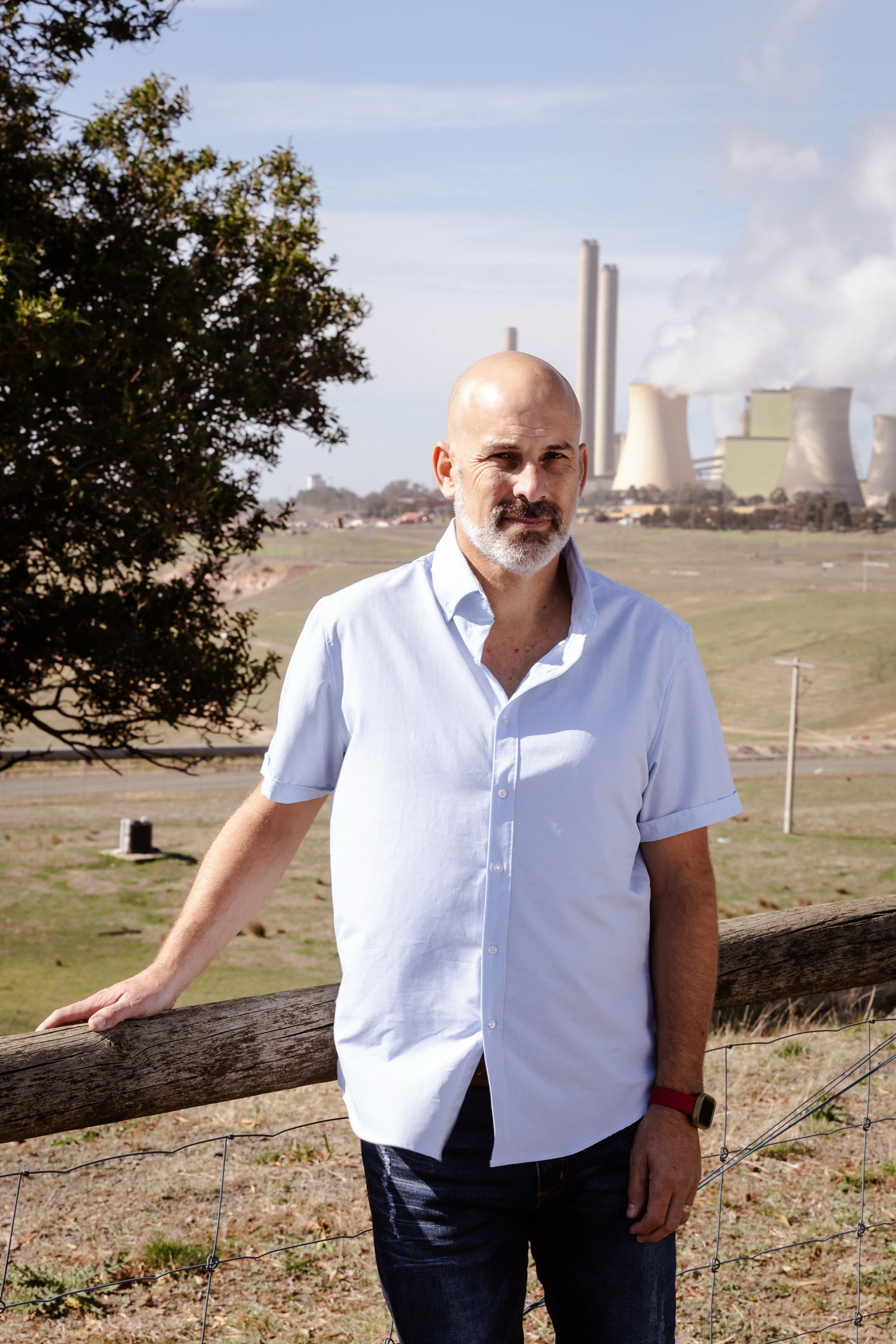
Jamie has worked in the Latrobe Valley coal industry his entire adult life. His wife was born in a town that no longer exists - replaced by an open-cut mine. He is not resisting the energy transition; he understands it is coming. What he is asking is whether it will be done with or to the communities that built Australia’s energy system - and whether a lifetime of work will count for something when the last turbine shuts down.
Through Jamie’s eyes
Jamie (he/him), 53 | Gunaikurnai Country (Traralgon, Victoria)
For more than fifty years, Jamie’s family has been anchored in the Latrobe Valley, a place where identity, livelihood, and national purpose were once tightly interwoven. His parents migrated from the UK when he was two, drawn to an Australia that promised stability through industry. His wife was born in a town that no longer exists, replaced by an open-cut mine that fed Victoria’s demand for electricity. Their lives, like thousands of others in the Valley, were built around work that kept the lights on for millions and offered a clear sense of contribution as they powered a nation.
This history is what makes one particular interaction linger in his mind. Someone asked where he worked and he replied, “Loy Yang B.” The reaction revealed a growing prejudice. The woman “totally berated me and then stormed off after I told her I worked at a coal station,” he recalls. “Maybe I should have said I was a brain surgeon.” The criticism mattered less to him than what it revealed: a quiet rewriting of who deserves dignity in Australia’s future. “Coal’s a dirty word now.”
Jamie is not resisting change. He knows the shift is underway. Closing the coal stations “could be a good thing,” he says, “if new and better opportunities are made available.” His concern lies in how the transition unfolds. He holds to a simple expectation: that a lifetime of work should count for something, and that communities who powered the country for decades should not be discarded the moment national priorities begin to shift.
The rupture he describes is not between coal and clean energy. It is between eras; an Australia built through industrial labour and an Australia that speaks of the future as though those workers no longer exist. Jamie has lived through the turbulence of privatisation, the erosion of apprenticeships, and the weakening of worker protections. He watched manufacturing collapse and investment drift offshore, each shift pushing the Valley further from the centre of decisions that continue to shape its fate. It all “feels like we’re getting hung out to dry,” he says. Decisions are made far from the places that carry their consequences. Workers who sought stable jobs and decent lives fall through the gaps of systems designed for efficiency rather than continuity.
Jamie’s story reminds us that energy policy is never only technical. It shapes identity, belonging, and the intergenerational contract between those who built the system and those who inherit it. His experience echoes across communities like the Latrobe Valley. What he asks for is simple: a transition that honours the work already done and ensures the Valley is not asked to pay twice, once for powering the country and again for a future that moves on without them.

The policy trajectory of Australia’s energy transition
Jamie’s experience in the Latrobe Valley describes an energy transition governed primarily as an infrastructure challenge, even though its effects unfold through labour markets, institutions, and community identity. Policy progress is measured through visible outputs such as plants closed, renewable capacity installed, and capital deployed. Far less attention goes to maintaining regional capability. When transition planning focuses on delivery targets alone, workforce pathways weaken, institutional knowledge disperses, and community confidence erodes. Reporting cycles reduce long regional transitions to short administrative milestones. Economic change continues, yet the social foundations required to sustain it receive little coordinated support. As national attention shifts elsewhere, regions are left with diminished capacity to adapt, rebuild trust, or remain active participants in the emerging energy economy.
The potential of future generations policy to intervene
A future generations policy lens treats continuity as a public asset within transition planning. Coordinating plant closures, investment flows, and workforce development would help retain skills, institutional knowledge, and regional confidence. This approach embeds social capability alongside physical infrastructure. Success is measured through the durability of regional participation in the new energy economy, ensuring that communities central to Australia’s industrial past remain positioned to contribute to its energy future.
Policy landscape
Today’s policy landscape: Australia's energy landscape
Australia’s move toward net zero is reshaping labour markets, institutions, and regional economies. In regions where closures concentrate, such as the Latrobe Valley, the transition tests whether national planning can deliver structural reform while sustaining social and economic continuity locally.
Victoria’s emissions targets and the planned closure of brown coal power stations concentrate disruption in a region that supplied low-cost electricity for decades. Even the mechanics of exit remain unresolved. Mine rehabilitation raises difficult questions about long-term water supply, as proposed rehabilitation pathways require securing large volumes of water and navigating complex approval processes for access and allocation. These uncertainties prolong risk for communities already navigating an unsettled future.
As coal assets wind down, the Latrobe Valley confronts more than an economic adjustment. The transition raises fundamental questions about regional identity, economic resilience, and how the risks and benefits of energy transformation are distributed.
Generational dynamics sharpen these tensions. Younger Australians often support rapid renewable expansion and see opportunity in emerging industries. Older workers whose livelihoods are more closely tied to legacy energy systems express greater caution. These perspectives shape competing expectations about fairness, predictability, and security. When pathways remain unclear or uneven, trust in transition governance weakens and legitimacy erodes.
National policy settings add further complexity. The Net Zero Plan directs major investment toward renewable generation, large-scale storage, and clean industrial development, including a AUD 2 billion Green Aluminium Production Credit and a AUD 1 billion Green Iron Investment Fund. At the same time, fossil fuel subsidies continue. These mixed signals reduce long-term planning certainty for both regions and investors.
Labour dynamics reveal both risk and opportunity. Regions such as the Latrobe Valley hold diverse deep capability across trades, services, and technical roles. This capacity strengthens the transition when new industries match existing skills, arrive early enough to absorb displaced workers, and provide accessible retraining pathways. In the absence of coordinated timing and planning, workforce capability remains underused and regional exposure to transition shocks deepens across generations.

The value of a future generations approach
Energy transition policy shapes more than emissions outcomes. It determines whether regions retain skilled workers, functioning training pathways, and institutional knowledge as industries change, or lose these assets when facilities close and national priorities shift elsewhere. When transition support is short-term, conditional, or triggered only at the point of closure, disruption repeats across communities. Workforce pipelines fragment, local employers disengage, and confidence in public planning weakens.
A future generations policy approach treats transition as a multi-decade process of retaining and redeploying capability. It asks whether closure planning, investment decisions, workforce development, and regional economic strategy are coordinated to carry skills, occupational identity, and productive capacity into emerging industries. Early planning grounded in local labour markets strengthens a region’s ability to adapt without prolonged dislocation. Reactive responses raise adjustment costs and make subsequent transitions harder to manage.
International and domestic experiences show that different outcomes are possible. In Norway, the Government Pension Fund converts extractive revenues into a permanent public asset, supporting economic stability across generations. Here in Australia, Collie’s Just Transition Working Group demonstrates how regional governance can retain skills, sustain trust, and guide economic change over extended timeframes instead of allowing disruption to arrive all at once and leaving communities to absorb it.
Future Generations Policy Analysis
A future generations policy lens places durability at the centre of transition design. Aligning closure planning, capital investment, and workforce development across labour market, regional, and environmental timeframes helps retain and redeploy capability. Skills, institutional knowledge, and community confidence carry forward into emerging industries. When this alignment is absent, adjustment costs fall repeatedly on the same communities. The way the transition is governed will determine whether regions adapt alongside economic change or whether disruption deepens across generations.
Case Study: The Energy Industry Jobs Plan & Clean Economy Workforce Development Plan
Australia has introduced new policy tools to manage the workforce impacts of the energy transition. The Energy Industry Jobs Plan, established under the Net Zero Economy Authority Act 2024, provides the most structured national mechanism to support workers affected by coal and gas closures. When activated, the plan grants enforceable rights to redeployment, retraining, and career support, shifting assistance from discretionary programs to legal obligations.
The plan’s scope remains limited. Activation occurs only when specific closures are announced, and support ends six months after a facility shuts down. This narrow timeframe restricts the system’s ability to address longer-term regional adjustment and raises concerns about whether transition support reaches future cohorts entering affected labour markets.
Victoria’s Clean Economy Workforce Development Strategy 2023-2033 addresses a different part of the challenge. The strategy sets a ten-year horizon for workforce development in emerging industries such as renewable energy, electrification, and advanced manufacturing. Its anticipatory design improves skills planning and signals future labour demand.
Workforce planning alone cannot determine where new jobs appear. Without coordination between training systems, industry investment, and regional development, workers risk retraining for roles that do not materialise locally. These initiatives establish the foundations of Australia’s just transition framework, but their effectiveness will depend on consistent activation, sustained funding, and alignment between skills development and labour demand.
Fairness dimensions
Life stage equity
Transition support is concentrated around moments of closure, favouring workers who can retrain or relocate quickly. Older workers and mid-career tradespeople face compressed timelines that interrupt mentoring roles and tacit knowledge transfer, which weakens capability pipelines just as regions most need continuity and yields thinner skills ecosystems to future transitions.
Distribution Across and Within Generations
Rights-based obligations improve immediate fairness for affected workers, yet conditional activation and uneven regional capacity mean support accrues unevenly. Over time, some regions retain adaptive capability while others experience repeated depletion, embedding geographic inequality in who carries transition risk across generations.
Future Opportunities and Path Dependency
Investment sequencing prioritises asset replacement over regional capability retention. When new industries arrive without aligned training, procurement, and local ownership pathways, regions inherit infrastructure without embedded skills or confidence, narrowing future options and locking regions into dependence on external operators rather than locally anchored renewal.
Proportionate and Justified Trade-offs
Short-term fiscal efficiency is achieved by limiting the duration and scope of transition support. The deferred cost appears later as workforce exit, lost institutional memory, and repeated intervention needs. These accumulated losses raise the long-term public cost of future transitions, shifting adjustment burdens forward in time.
Precautionary Approach
Governance triggers respond after closure decisions are announced rather than acting early to preserve capability, which delays intervention until disruption is unavoidable and normalises crisis management. Future governments inherit systems calibrated to respond late, long after thresholds are crossed.
Our opportunity to shape Australia’s future
Australia’s energy transition tests continuity as much as emissions reduction. Climate risk demands rapid change, yet transition design that prioritises speed without sequencing places regional systems under strain. When closure timelines, investment decisions, and workforce planning move within short policy cycles, skills pipelines break. Local institutions struggle to adjust. New industries appear without the social and organisational foundations needed to sustain them.
Two possible futures
The transition that fractured a community
It is 2040, and the rupture has become structural. Coal closures proceeded on schedule, yet support remained fragmented. Jobs disappeared as new industries stalled or bypassed the region entirely. Younger people left in search of work. Older workers entered retraining pathways that never translated into employment close to home. The Valley slowly became shorthand for abandonment, suspended between what it had been and what it had been promised it would become.
The quiet dismissal of the Valley’s contribution hardened into policy decisions that moved forward without it. Distrust deepened as communities watched the country take what it needed and then move on. Nationally, the shift to clean energy was declared a success. Targets were met, infrastructure expanded, and reports praised efficiency. The social costs were written out of the narrative and absorbed by communities already carrying the weight of industrial decline. The Valley paid twice. It powered Australia for generations, then absorbed the fallout of a transition that treated it as an afterthought.
By 2040, the divide between regions invited into the future and those left behind has widened. In the Valley and in places like it, children grow up surrounded by absence: shuttered workshops, empty main streets, stories of work that once anchored families and communities. The legacy of contribution survives mostly in memory and footnotes, carried forward by a generation that remembers what the country chose to forget.
The valley as a model for fairness
It is 2040, and the Latrobe Valley stands as proof that transitions designed with care can restore trust across generations. The coal stations are closed, yet the people who powered the nation for decades did not disappear into the margins. They were among the first partners in planning. Their experience shaped the decisions that followed, allowing them to carry their skills into the emerging energy economy.
Preparation began years before the final turbines shut down. Local TAFEs expanded their programs and apprenticeships returned as a central pathway into the region’s industries. Workers who once maintained boilers now operate grid batteries, geothermal drilling systems, recycling plants, and electrified transport networks. The deep operational knowledge built in the old energy system became a foundation for the new one.
Community hubs anchored the transition. They provided job matching, counselling, childcare, and financial support for families navigating change. These spaces recognised the lives behind the statistics and treated transition as something lived in households and workplaces, not simply administered through policy. Progress is now measured by who remains included. A new generation is growing up in a region that reflects continuity instead of loss.
By 2040, the Valley has become a widely studied example of intergenerational fairness in practice. It shows that a country can change direction without discarding the people who carried it through the last century. The community has renewed itself, and the line between generations holds.






Go deeper