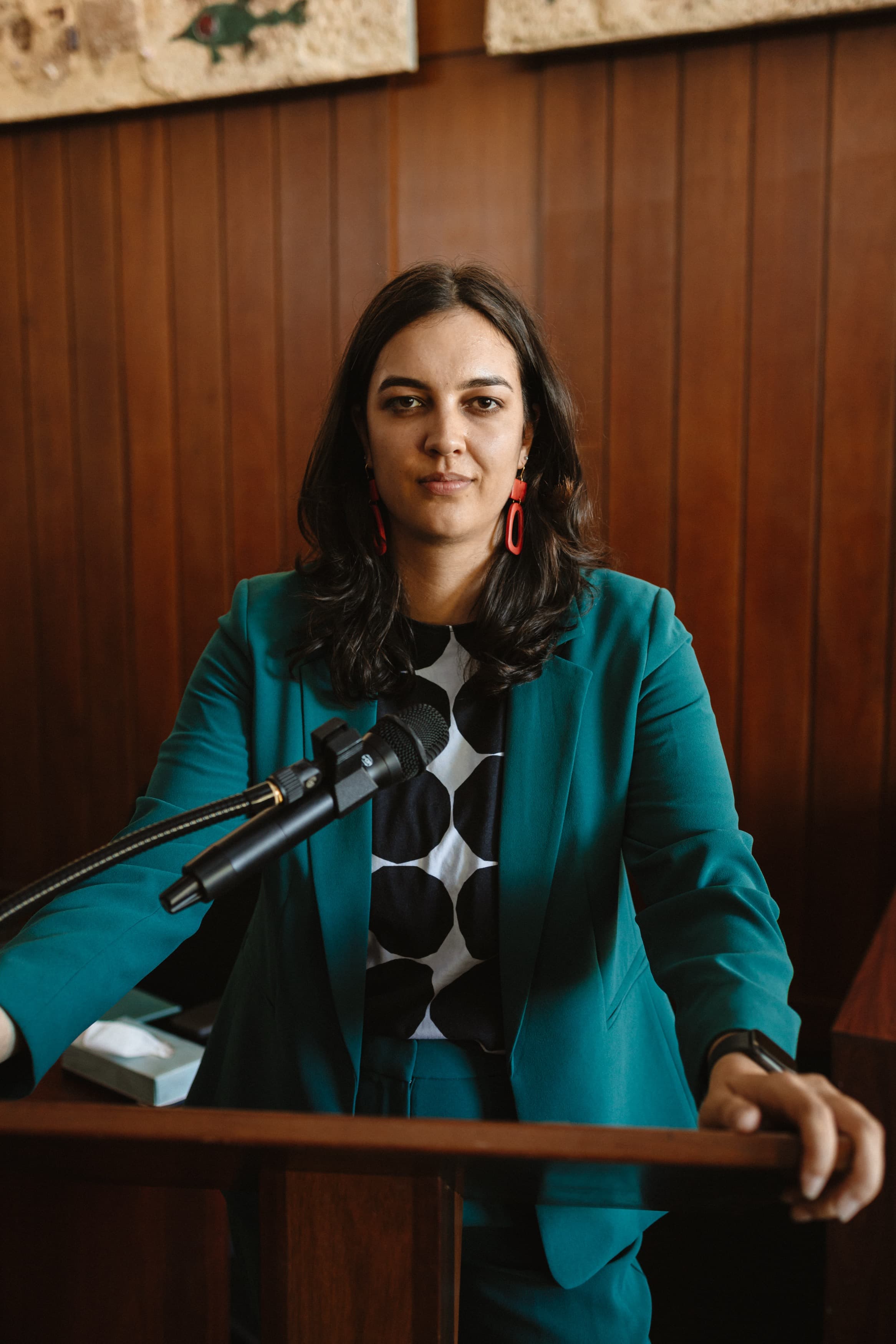
Portrait 12 of 15
Georgie
Renewing Democracy’s Architecture from the Ground Up
she/her · 30 · Whadjuk Noongar Country (Mosman Park), WA
Local democracy · Civic participation
She ran for council at 21, beat an incumbent, and was called ‘kiddo’ in the chamber. She is Deputy Mayor.
Georgie entered local government as a teenager looking for community after moving thirteen times with her mother and brother. By 21 she was an elected councillor. By 25, Deputy Mayor. What she found was a system whose basic design - unpaid roles, rigid eligibility rules, barely livable remuneration - quietly filters out anyone without home ownership, stable income, or accumulated savings. Her portrait examines why democracy keeps producing councils that don’t look like the communities they govern, and what it would take to build one that genuinely does.
Through Georgie’s eyes
Georgie (she/her), 30 | Whadjuk Noongar Country (Mosman Park, Western Australia)
Georgie entered local government the way many young people enter public service: out of necessity. At fifteen, after moving thirteen times with her mother and brother, she was searching for community and a place to belong. She found it in the Mosman Park Youth Advisory Council, a small room where young people could speak and adults occasionally listened. “Joining made me feel connected and part of my local community,” she says. When Julia Gillard became Prime Minister, Georgie was in Year 9. “It felt like women really had a place in politics,” she recalls. “I think that was a big motivation for me.”
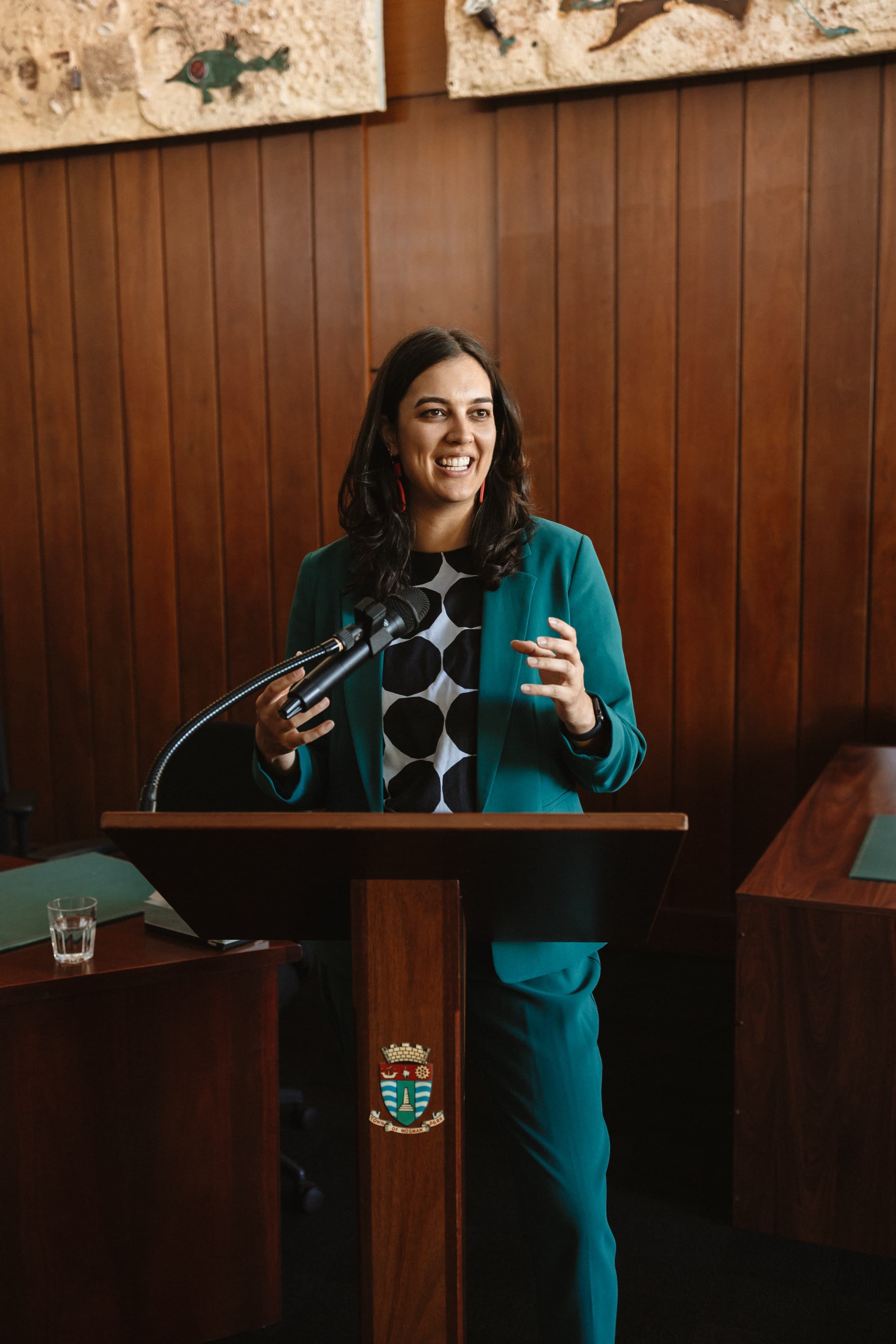
Mosman Park spans four square kilometres, and contains seven schools, with nearly a third of residents under twenty-five. The council did not reflect that reality. “So I put my hand up and did it.” At twenty-one, she ran for council, beat an incumbent, and entered a chamber where she was often treated as an exception. “I was even called kiddo one time. No, I am Councillor Carey.” Representation, she learned, did not end with election. It required insisting on belonging in a system never designed with her in mind.
By twenty-five, she had become Deputy Mayor and was experiencing firsthand the contradictions of local government: the expectation to serve selflessly while confronting the same structural barriers that prevent many younger people from running in the first place. She watched how systems built around home ownership, stable work, and accumulated savings quietly filtered out those living with precarity.
Her case for youth representation is grounded in lived experience. Younger people, she argues, “understand emerging challenges from the inside”: housing precarity, climate impacts, digital governance, mental health. They also have “less attachment to entrenched political identities and institutions,” and are more willing to “confront long-term issues because they’ll live with the consequences.” Their presence changes how decisions are framed, expanding the system’s field of vision and bringing future impacts into present deliberations.
Yet exclusion remains embedded in the system’s basic design. Commitment cannot bridge gaps when campaigning costs money, service requires unpaid hours, and councillor remuneration remains barely livable. “Most of us still work part-time just to make it work,” Georgie says. Housing instability makes residency requirements harder to meet. “My rent has gone up astronomically,” she notes, “but I have to stay because I’m deputy mayor.” Prejudice persists too, including the assumption that young people lack “enough life experience.” These pressures form an invisible governance tax paid simply to participate.
Still, she remains hopeful. “We have a way to go to get a representative local government, but we are getting there.” For Georgie, youth representation is a democratic standard. One young councillor is not enough. “Build cohorts,” she insists, “so no single young representative is isolated or overburdened with representational labour.” Change happens through numbers, not exceptions. As pathways widen, expectations shift. “I stepped into politics at twenty-one thinking I was too young to matter, and I’ve learned the opposite. Sometimes the least expected voice is the one a community needs most.”
What she wants now is simple and radical at once. “That every young Australian feels permission to show up, speak up, and shape the world around them.” This, to her, is the unfinished work of democracy. Local governments, closest to daily life, can trial new models to make that invitation real. “If we want a fairer, braver Australia, we need more people, especially youth, participating, questioning, imagining, and leading.” The question is how policy can make stepping forward less costly.


The policy trajectory of democratic participation
Georgie’s experience reveals a democratic system where access to participation depends heavily on economic security, housing stability, and available time. These conditions determine who can engage long before civic experience has the chance to develop. Local governance arrangements prioritise procedural compliance and administrative efficiency, while participation is treated as intermittent engagement rather than sustained involvement. For younger and less secure residents, entry into local decision-making is often brief. Unpaid roles, limited compensation, and rigid eligibility rules create predictable exit points during periods of financial pressure or life transition. As participants leave, institutions lose continuity and lived experience disappears with them. The result is decision-making shaped by a narrower range of social conditions, reducing local governance’s capacity to anticipate emerging needs, align policy across life stages, or guide long-term social change.
The potential of future generations policy to intervene
A future generations policy approach recognises democratic participation as infrastructure for long-term institutional capability. Designing civic roles that remain viable across life stages through fair remuneration, flexible pathways, and cohort continuity enables sustained civic learning and reduces reliance on individuals absorbing the personal costs of participation. Retaining experience within institutions strengthens contextual understanding and supports steadier governance as social conditions evolve. Decision-making remains grounded in the realities communities live with, strengthening democratic legitimacy and improving the capacity of institutions to govern for future generations.
Policy landscape
Today's policy landscape: Democracy and the participation gap
Australia’s democratic system retains broad legitimacy, yet confidence in how it operates has weakened. Many Australians still support democratic principles, but fewer feel that institutions reflect their lives or respond to their concerns. This gap shapes who participates and whose voices carry weight in decision-making. Electoral incentives reward short-term visibility, while challenges in housing, climate, and infrastructure require stewardship across decades.
Representation remains uneven. Young people, renters, and historically marginalised communities continue to hold less influence within formal politics. Insecure work, rising rents, and limited discretionary time place practical limits on participation. As these pressures intensify, political voice increasingly tracks economic security rather than citizenship, narrowing the range of lived experience informing policy.
Younger Australians continue to value democracy but often channel their engagement through community initiatives, advocacy, and civic action outside formal institutions. Many view higher levels of government as distant or unresponsive. Local government remains the most accessible entry point into formal politics, offering proximity to everyday concerns and fewer symbolic barriers to entry. When these pathways weaken, early civic motivation fades.
The implications reach beyond participation rates. Younger Australians are the first generation expected to be worse off than their parents, facing record housing stress and declining wealth accumulation while older households have seen significant gains. When those most affected by long-term policy decisions struggle to access representation, the capacity of democracy to steward fairness across generations begins to fray.

The value of a future generations approach
Australia’s democratic participation settings determine who can enter, remain, and progress within local governance. When participation assumes stable housing, secure income, and discretionary time, many residents cannot sustain involvement. People living with housing and employment insecurity, including many younger Australians, enter councils and advisory bodies in small numbers and leave quickly. Participation demands, remuneration structures, and eligibility rules place sustained pressure on transitional life stages. High turnover weakens institutional memory, disrupts leadership pipelines, and limits councils’ access to the lived experience needed for long-range social and economic planning.
A future generations policy approach recognises participation as democratic infrastructure that requires deliberate investment. It asks whether local governance arrangements allow people to remain engaged across life stages through fair remuneration, flexible pathways, and clear progression into leadership roles. Where experience remains within institutions, councils retain decision-making continuity and draw on a wider range of lived realities when setting priorities. This strengthens their capacity to anticipate and manage emerging challenges across longer time horizons.
Local governments elsewhere demonstrate that alternative designs are possible. Barcelona’s Decidim platform provides standing digital participation channels between elections, allowing civic input to continue as personal and economic circumstances shift. Porto Alegre’s participatory budgeting embeds recurring public involvement in fiscal decisions, shaping priorities across successive budget cycles. These models show how participation pathways can either narrow as precarity rises or be designed so future communities inherit institutions structured for broader engagement.
Future Generations Policy Analysis
A future generations policy lens focuses attention on what capability institutions carry forward. Governance settings that allow people to remain involved across life stages help retain practical knowledge, sustain leadership pathways, and extend planning horizons. Systems designed this way maintain continuity in decision-making and strengthen councils’ ability to anticipate and manage long-term change. Where participation relies on episodic engagement, councils must repeatedly rebuild experience as conditions shift.
Case Study: Western Australia’s Local Government Electoral Framework
Western Australia’s Local Government Act 1995 governs participation in the level of government closest to daily lives. While designed to operate neutrally, many of its provisions reflect assumptions about stable housing, secure income, and available time that no longer match contemporary social and economic conditions.
Councillor remuneration, typically ranging from AUD 4,000 to 35,000 per year, often requires officeholders to rely on supplementary income or financial security. Campaign costs are largely privately funded, and residency requirements can disadvantage renters and people in more transient housing arrangements. These features shape who is able to run for office, contributing to councils that are older and more economically secure than the populations they represent.
Consultation provisions under the Act also produce uneven participation pathways. Requirements are broad and leave councils significant discretion in how they engage communities. Some councils invest in youth advisory bodies, deliberative forums, or co-design processes, while others rely on more conventional consultation formats such as written submissions and public meetings. These formats tend to favour residents with greater time, confidence, and familiarity with institutional processes.
Fairness dimensions
Life stage equity
Participation settings presume stability, normalising early exit from civic roles and interrupting leadership development. Over time, this thins capability pipelines and leaves future decision-makers with reduced exposure to emerging social conditions and fewer pathways for leadership renewal.
Distribution Across and Within Generations
Access to decision-making favours economically secure participants, skewing local knowledge and locking in epistemic blind spots that future councils inherit.
Future Opportunities and Path Dependency
Repeated exclusion narrows retained risk tolerance and policy experience, further entrenching conservative decision norms and shorter planning horizons over time.
Proportionate and Justified Trade-offs
Low upfront investment in participation design shifts costs to individuals, which defers investment in democratic capability while accumulating hidden liabilities in disengagement, reactive consultation, and higher remediation burdens.
Precautionary Approach
Rigid eligibility assumptions risk locking in participation gaps as economic volatility and housing mobility increase, reducing future capacity to re-establish broad access once eroded.
Our opportunity to shape Australia’s future
Local democratic systems face a design choice in how they sustain participation. When access to representation presumes stable housing, secure income, and discretionary time, many residents cannot remain involved. Leadership turns over quickly and experience leaves institutions before it can strengthen decision-making. Councils operate with thinner decision histories and narrower leadership pipelines, limiting their ability to plan across housing, infrastructure, and service pressures that unfold across decades.
Two possible futures
A future hollowed by exclusion
It is 2040, and local democracy has settled into a familiar pattern of decline. The average age of councillors continues to climb as rising rents push younger residents out of the communities they once hoped to represent. Campaigning remains expensive and opaque. Remuneration never adjusted to reflect early-career realities. Participation feels less like a civic right and more like a privilege reserved for those with surplus time, stable housing, and independent income.
Councils still speak earnestly about “engaging youth” while filling their chambers with the same narrow slice of experience. Civic education remains largely theoretical, leaving new generations distant from institutions they were rarely invited to understand. Media coverage reinforces the pattern, portraying young leaders as anomalies rather than contributors. Participation contracts to those who already know how to enter.
The effects ripple through the entire system. Without younger representatives, policy reflects the perspectives of those further removed from emerging realities. Housing precarity is debated in rooms where it is rarely lived. Climate decisions favour caution over transition. Digital governance drifts, shaped by people who did not grow up inside the systems they regulate. Younger citizens turn toward parallel civic spaces, building meaning and belonging outside democratic institutions altogether. The distance Georgie once crossed grows wider, harder, and lonelier.
Democracy erodes as cross-generational trust fractures. Inequality deepens, invitations to participate remain uneven, and short-term political incentives dominate decision-making without the presence of long-term voices to temper them. Participation rules and design flaws persist without correction. By 2040, the system still functions on paper yet feels hollow in practice: decisions serve the present only because those who will inherit the consequences were never in the room.
A future strengthened by us
It is 2040, and Australia’s democracy is recognisably different. The barriers that once kept young people at a distance were deliberately dismantled. Governance training became accessible and publicly funded, helping first-time candidates understand compliance, budgeting, and decision-making. Campaigning became transparent and affordable. Remuneration was adjusted to reflect the realities of early careers and limited savings, allowing representatives to serve without financial strain. Residency requirements were updated to recognise the instability of modern housing, introducing flexibility that better reflects how people actually live.
The change is most visible inside council chambers. They now resemble the communities they represent. Younger representatives enter in cohorts rather than as isolated exceptions. Their presence is expected and reshapes how decisions unfold. Housing policy reflects the lived experience of unstable leases. Climate planning draws on the perspectives of those who will live longest with its outcomes. Digital governance benefits from insight provided by people who grew up inside the systems now being regulated. Media coverage reflects this shift. Young leaders are recognised for their decisions and contributions, and their age is no longer the headline.
Local governments also widened the pathways into public life. Citizen juries, youth assemblies, neighbourhood forums, and accessible digital platforms bring participation closer to everyday life. Civic learning begins early and remains practical, helping people understand how decisions are made and how influence can be exercised. Participation now resembles jury duty more than volunteerism: structured, supported, and recognised as part of shared civic responsibility.
The democracy that has emerged is more representative and more capable of navigating the decades ahead. Representation reflects the diversity of the country, decision-making integrates long-term stewardship alongside present needs, and institutions are structured to serve the full breadth of the public they govern.

Go deeper